Create Interactive Quizzes in Seconds
Simply upload a PDF, paste a URL, or provide text. Quizzify's powerful AI analyzes your content and automatically generates accurate, relevant questions. Stop wasting time and start engaging your audience.
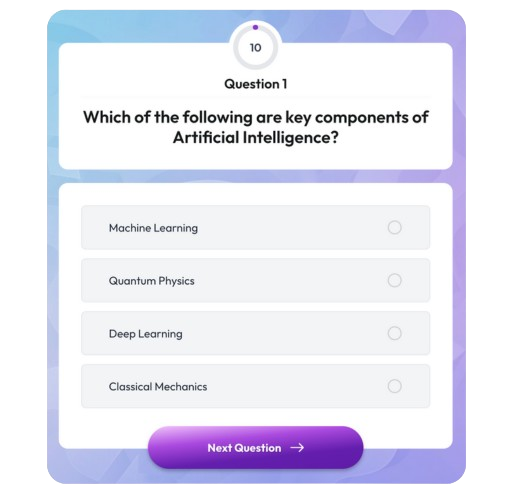
Everything You Need for Interactive Learning
Transform your static content into dynamic quizzes and assessments with our AI-powered tools. No more manual question creation.
Multiple Content Sources
Your knowledge lives everywhere. Now, so can your quizzes. Whether your material is in a detailed PDF report, a live webpage, or simple pasted text, our AI is ready to transform it into an assessment tool in seconds.
URL Content Quiz Builder
Don't just link to content—assess it. Point our AI to any URL, from a single blog post to a multi-page guide. It intelligently crawls, comprehends context, and generates precise questions that reflect the core information on the page.
Smart MCQs & Questions
Our AI crafts challenging questions with plausible distractors and provides automatic explanations for correct answers to reinforce learning.
Interactive Polls
Engage your audience in real-time. Instantly create live polls to gauge understanding or gather opinions during a presentation or lesson.
Export Results
Turn quiz results into actionable insights. Download detailed performance reports, track individual and group progress, and analyze response patterns.
Collaboration
Invite colleagues to a shared workspace. Co-create quizzes, manage a central library of assessments, and set permissions to streamline your workflow.
Revolutionizing Learning with AI
The traditional process of creating assessments is a major hurdle for today's fast-paced learning environments. Manually drafting questions, ensuring they cover key topics, and creating varied formats is tedious work that steals valuable time from educators and trainers. Often, the end result is a simple quiz that only scratches the surface of true comprehension.
Quizzify changes the game. Our platform leverages advanced AI that goes beyond keyword matching. It reads and digests your source material—be it a dense research paper or a simple webpage—with human-like understanding. By analyzing context, hierarchy, and key concepts, Quizzify crafts meaningful questions that challenge learners and accurately measure their grasp of the material.
Who Uses quizzify?
-
Educators who need to save hours on lesson prep and create more effective assessments that improve student retention.
-
Corporate Trainers tasked with verifying employee knowledge, ensuring compliance, and maximizing the impact of training programs.
-
Content Creators looking to transform static content like blog posts and guides into interactive experiences that captivate their audience.
How It Works
Provide Your Content
Simply drag and drop any PDF, paste text directly, or enter a URL. From a single article to a full textbook chapter, your content is our starting point.
AI Performs a Deep Analysis
In seconds, our AI reads and understands your material. It identifies core concepts, critical facts, and the relationships between them to find the most valuable information for assessment.
Your Quiz is Instantly Generated
A complete, relevant quiz is created automatically. Our system generates a variety of question types, including multiple-choice with intelligent distractors, to ensure a robust test of knowledge.
Review, Customize, and Share
You have the final say. Effortlessly edit, add, or delete questions. When you're ready, share your quiz with a simple link, embed it on your site, or export it for your LMS.
Explore Our AI in Action
Browse a live gallery of examples and preview the quality of our AI-generated questions firsthand. Discover what's possible for your content.
HISTORIOGRAFIE LATIJN EXAMEN
HISTORIOGRAFIE Traditioneel laat men de geschiedschrijving in Europa beginnen met de Griekse schrijver Herodotus, die in de vijfde eeuw voor Christus de Historiae schreef. Het belangrijkste onderwerp is de geschiedenis van de conflicten tussen de Grieken en de Barbaren, waarmee hij verschillende volkeren uit het oosten en dan voornamelijk de Perzen bedoelt. Het hoogtepunt van deze conflicten waren de zogennaamde Perzische oorlogen. Herodotus maakt echter ook vele zijsprongen naar andere geschiedskundige en geografische onderwerpen en hij last ook heel wat anekdotes in. Ook voor Herodotus waren er al chronieken geschreven, chronologische verslagen van gebeurtenissen jaar na jaar, maar Herodotus was de eerste om een aantal principes te hanteren die in de latere geschiedschrijving essentieel zouden worden. Zo probeerde hij verbanden te zoeken tussen gebeurtenissen, zocht naar oorzaken, probeerde een onderscheid te maken tussen eerder wel en eerder niet betrouwbare bronnen en hij ging zelf op onderzoek uit. Hij heeft daarbij een groot gebied afgereisd. Al in de oudheid kreeg hij de bijnaam Vader van de geschiedschrijving. In het Latijn, Pater Historiae. De tweede grote Griekse geschiedschrijver was Thucydides, een tijdgenoot van Herodotus. Hij schreef over het slag over de Peloponnesische oorlog tussen Athene en Sparta, die hij zelf ook meemaakte. Meer dan Herodotus schreef hij strict onpartijdig, deed hij uitgebreid bronnenonderzoek, zocht hij naar dieperliggende oorzaken.( Hij was de eerste om een onderscheid te maken tussen de oorzaak en de aanleiding van de gebeurtenis.) Anders dan Herodotus deed hij ook geen enkel beroep op de goden om bepaalde gebeurtenissen te verklaren. Hij hechtte daarentegen veel belang aan de psychologie; De geschiedenis wordt gestuurd door het gedrag van individuele mensen, en dit gedrag wordt op zijn beurt veroorzaakt door drijfveren als angst en het naschrijven van eigen belang. Zoals op zoveel vlakken hebben de Romeinen ook het genre van de geschiedschrijving van de Grieken overgenomen en de eerste Romeinen die over het eigen Romeinse verleden schreven, deden dat in het Grieks. De eerste Romein die in het Latijn een geschiedskundig werk schreef, was Cato, de grote voorvechter van de mos maiorum en tegenstander van alles wat Grieks was. De schrijvers die als de grootste Romeinse geschiedschrijvers worden beschouwd, moeten allemaal gesitueerd worden in de eerste eeuw voor Christus en de eerste, slechts begin tweede eeuw na Christus. Caesar, Sallustius, Livius, Suetonius en Tacitus. Caesar was in de eerste plaats een van de belangrijkste politici uit de eerste eeuw voor Christus en voor ons van bijzondere betekenis omdat hij onze gebieden bij het Romeins Rijk heeft toegevoegd. Om deze redenen, en ook omdat zijn taal als het voorbeeld bij uitstek van klassiek Latijn wordt beschouwd, is Kajzar sinds de 16e eeuw een schoolauteur. Zijn geschiedkundige werken zijn sterk autobiografisch, zowel in De Bello Gallico als in De Bello Civili speelt hij zelf de hoofdrol. Zijn bedoeling met deze werken was zeker niet als een wetenschapper aan objectieve geschiedschrijving doen, maar wel zijn eigen optreden verantwoorden. Sallustius, ( 86 tot 35 v.C.), schreef enkele monografieën, vrij korte weg over één specifieke gebeurtenis, met name over de oorlog van de Romeinen tegen de Numidische koning Jugurtha (Algerije) (tussen 111 en 105 v.C.), en over de samenzwering van een zekere Catilina in het jaar 63 v.C., het jaar waarin Cicero consul was. Sallustius, die zelf tot de populares behoorde, had een duidelijke bedoeling met het schrijven van zijn werken. Hij wilde aantonen dat Rome in verval is, doordat de Romeinen corrupt zijn geworden en zich niet meer laten leiden door de mos maiorum, maar door heel andere motieven; de zeer slechte en onderling verschillende kwalen, luxezucht en hebzucht. Hij legt de schuld hiervoor volledig bij de optimates. De bekendste geschiedschrijver uit de tijd van keizer Augustus is Livius. (59 v.C. tot 17 n.C.. In zijn Ab Urbe Condita wilde hij de hele Romeinse geschiedenis weergeven vanaf de stichting van de stad, 753 v.C., tot in zijn eigen tijd. Zeker voor de vroege geschiedenis van Rome is zijn werk een mengeling van geschiedenis en mythologie. Livius beseft dit zelf ook. In zijn voorwoord geeft hij aan dat hij niet de bedoeling heeft om deze 'verhalen die eerder getuigen van poëtische legendes dan van betrouwbare historische feiten' als absolute waarheid te bestempelen, maar ook niet om ze zonder meer af te wijzen. Livius hechtte, net zoals Sallustius, veel belang aan de mos Maiorum en vond dat het op een bepaald moment in de geschiedenis de verkeerde kant is uitgegaan. Zijn bedoeling is beroemde Romeinen uit het verleden opnieuw onder de aandacht te brengen, die met hun woorden en daden de goede oude zeden belichaamden en zo Rome meer grootgemaakt hebben. Hij hoopt ongetwijfeld dat ze als voorbeeld zouden dienen voor zijn tijdgenoten. In dat opzicht sluit hij weer perfect aan bij de politiek van keizer Augustus, die ook de mos Maiorum wilde doen heropleven. Van zijn omvangrijke werk, 142 boeken, is slechts een kwart bewaard, vooral de vroege geschiedenis en de Tweede Punische Oorlog. Hoewel niet in alle tijden erg populair, vooral wegens zijn aparte schrijfstijl, is Tacitus, 55 tot 117 na Christus, zeker een van de grootste geschietschrijvers uit de oudheid. In zijn twee hoofdwerken, de Historiae en de Annales, behandelt hij respectievelijk de periode van 69 tot 96 na Christus en de periode die daaraan voorafgaat, van 14 tot 69 na Christus. Zoals hij zelf in de eerste paragraaf van de Annales aangeeft, is het zijn bedoeling de geschiedenis van de vroege keizertijd weer te geven sine ira et studio; zonder razernij en sympathie. Hoewel hij daar zeker niet altijd in slaagt ( hij is een duidelijk voorstander van de republiek en heeft vaak openlijk kritiek op keizers) probeert hij wel op een kritische manier aan geschiedschrijving te doen, waarbij hij bronnen met elkaar vergelijkt, duidelijk maakt wanneer iets slecht en gerucht was, soms ook aangeeft dat er geen zekerheid bestaat over wat er op een bepaald moment werkelijk gebeurd is. Suetonius, 69 - 122 na Christus, een tijdgenoot van Tacitus, behandeld dezelfde periode, maar dan in de vorm van biografieën. De zogenaamde De Vita Caesarum, het leven van de keizers. Hoewel Suetonius voor ons een belangrijke bron is voor feiten over deze periode, zeker over de jaren die in het werk van Tacitus verloren zijn gegaan, doet zijn werk vaak aan als een soap met een opeenstapeling van pikante details en grote roddels. Enkele genrekenmerken; Het is moeilijk om uit enkele eeuwen aan geschiedkundig werk veel algemene regels en kenmerken te halen. Toch zijn er zeker enkele kenmerken te onderscheiden voor de historiografie van de Romeinse oudheid. Een eerste belangrijke kenmerk is dat de geschiedschrijving in prozavorm gebeurt, geen poëzie dus! Historiografie kan verschillende vormen aannemen. Populair in de Romeinse oudheid zijn vooral biografieën, monografieën ( werk over één bepaalde historische gebeurtenis) en analyses. (het beschrijven van de geschiedenis jaar per jaar.) De schrijvers geven vaak hun persoonlijke mening over de gebeurtenissen en personen die het beschrijven. Naast hun persoonlijke mening is er ook vaak sprake van regelgerichte propaganda. Dit kan zowel propaganda zijn voor de schrijver zelf(Caesar), of breder voor de Romeinse mos maiorum, (Livius, Sallustius) Zoals virtus, (dapperheid niet alleen in de oorlog, maar ook op het thuisgrond. )En pietas,( plichtsbesef tegenover de familie, het vaderland en de goden.) Sommige van deze kenmerken zijn natuurlijk niet uniek voor de Romeinse oudheid, maar samen geven ze een goede indruk van hoe er in deze periode aan geschiedschrijving werd gedaan.
historia tema 2
Felipe V impuso una monarquía absoluta inspirada en la francesa tratando de convertir la corte real en el único centro de decisión. El rey castigó a los territorios de la Corona de Aragón por considerar que lo habían traicionado e invocó el derecho de conquista. Mediante los Decretos de Nueva Planta (1707-1715) abolió las Cortes, fueros, diputaciones generales, aduanas y sistemas fiscales de la Corona de Aragón, siendo sustituidas en su mayor parte por otras de nueva creación. Esto supuso la unión jurídica e institucional de España logrando una administración centralizada; sólo Navarra y las Provincias vascas conservaron sus fueros y su sistema fiscal por su fidelidad al bando borbónico durante la guerra. De esta manera, el gobierno polisinodial de los Austrias fue sustituido por el de gabinetes estatales formados por ministros o secretarios. Las funciones de los antiguos Consejos se trasladaron a las Secretarías de Estado y de Despacho, divididas en Guerra, Marina, Estado y Justicia, siendo el antecedente de los actuales ministerios. Las Cortes de los diferentes reinos (salvo las navarras), se integraron en las Cortes Generales del Reino, que en la práctica sólo se convocaban para jurar a los herederos de la Corona. Durante el reino de Fernando VI (1746-1759) se planeó la reforma de la Hacienda Real, comenzando por Castilla, diseñando una única contribución. Para ello el marqués de la Ensenada, ministro de Hacienda, elaboró el catastro, un estudio de los habitantes, propiedades territoriales, edificios, ganados, oficios, rentas, e incluso las características geográficas de cada población, para así recaudar impuestos de una manera más eficiente y ajustada. Esta reforma se vio frustrada por la oposición del clero y la nobleza (que seguían sin pagar impuestos), haciendo patente el poder que mantenían los estamentos privilegiados y los límites reales de la monarquía absoluta. La mayoría de la población vivía en áreas rurales y sobrevivía mediante una agricultura y ganadería de subsistencia. El problema era que alrededor del 75% de la tierra pertenecía a los estamentos privilegiados, pudiendo distinguirse las llamadas “manos muertas” de la Iglesia (terrenos que no se podían vender), los mayorazgos de la nobleza (conglomerados de terrenos destinados de manera indivisible en herencia al primogénito) y los realengos (propiedades del rey). Este sistema era criticado por los Ilustrados (fisiócratas) al estar muchas de estas propiedades abandonadas y no ser productivas. Carlos III (1759-1788) llevó a cabo reformas económicas como la cesión de tierras despobladas en Sierra Morena para que fueran pobladas por familias de colonos (1767) y la liberalización del comercio de cereales (1765). También desplegó políticas regalistas con la disolución de la Compañía de Jesús (1773), por su carácter antirreformista. Además, a lo largo del siglo, los soberanos fundaron manufacturas reales (tapices, vidrio, artillería, textiles, etc.) que, aunque crearon muchos puestos de trabajo, a la larga resultaron poco rentables. Se procuró mejorar la explotación de los virreinatos americanos para obtener más recursos. Para ello se crearon los virreinatos de Nueva Granada y del Río de la Plata, que se segregaron del de Perú. Sin embargo, el cambio más trascendental fue el fin del monopolio comercial de la Corona y del sistema de la Flota de Indias. Entre 1765 y 1778, Carlos III permitió el libre comercio entre varios puertos españoles y americanos, lo que estimuló ciertas exportaciones, especialmente de licores y textiles catalanes, lo que aportó un notable auge a las manufacturas de Cataluña. Estas reformas no estuvieron exentas de críticas e, incluso, de rebeliones, como la liderada por el indígena Tupac Amaru en Perú contra la mita y la esclavitud.
anj
PRE-TEST Flat structure means that staff are organised on various levels, depending on responsibility, with, for example, junior and senior managers. hierarchical structure Company structure is a term used for planning a series of actions in order to achieve company goals. company strategy An office without walls dividing it into separate rooms is called a closed office. open-plan office What term is used for the place where the business of buying and selling shares by companies is done? stock exchange What term is used for the state that a company may declare when it runs out of money and is not able to pay its debts? Bankruptcy What term is used when borrowing money becomes difficult because banks reduce the amount they lend and charge high interest rates? credit crunch What term is used for a difficult time when there is less trade or business activity in a country than usual? Recession For example, 11. i______ p______ (when new team members are introduced and trained into a new job) help them feel part of the company’s culture. induction programmes Training can help drive a proactive and lifelong process of advancing one’s professional path, called 12. c______ d______. career development long-term programmes focus on a wider 13. s______ s______, meaning a combination of different abilities needed to do a particular job. skill set Training can have various forms or 14. d______ m______ (how it is organised): be it in-house, on the job, face to face, online or blended. delivery methods Mentoring has proved to be very useful, too; its participants, called 15. m______, together with their experienced mentors seek resources for learning … mentees A skilful tutor will explain the difference between a professional debate in which you have a particular idea or interest and follow what is best for you, called a 16. p______ n______, and a 17. p______ n______ in which both parts look for common interests and what is good for them. 16.positional negotiation 17.principled negotiation The term 18. d______ t______ refers to new ways of doing things that completely change the existing market, pushing existing businesses to the side. disruptive technology The term 19. d______ m______ describes a process of using a computer to examine large amounts of information, e.g. on customers, in order to find out what is not easily noticed at first sight about them. data mining Regarding digital marketing, the term 20. c______ corresponds to the number of sales generated in relation to the number of visits to a website. conversion rate Identify a mistake in a sentence. Write the correct term. A set of principles and practices that a company feels are important, e.g. equal pay for male and female workers, refers to company image. Company values WORKPLACE CULTURE 1. Company hierarchy refers to staff organised at different levels of responsibility in a 2. 3. 4. 5. 6. 7. 8. 9. company. The values of a company are the beliefs and principles that the company considers important. Organisational behaviour looks at how people in an organisation work together and how this affects the organisation as a whole. A good atmosphere in a company means that employees enjoy working there and have good relationships with each other. A strategy is a plan for achieving an aim. Company structure means the way that the company is organised into departments and levels of responsibility. The image of a company refers to the way the company is seen by the public. An open-plan office is one which does not have walls dividing it into separate rooms. Flexibility refers to people or plans that can be changed easily to suit any new situation. EMPLOYEE RETENTION • Menial tasks – work which needs little skill • Sabbatical – a fixed period of time when someone takes an agreed break from their job • Promotion – the fact of getting a better paid, more responsible job • Work-life balance – a situation in which you are able to give the right amount of time and effort to your work and to your personal life outside work • Diverse work – jobs that are very different from each other TRAINING AND DEVELOPMENT 1. 2. 3. 4. 5. 6. Training courses can help to drive career development. A key part of the induction programme is to help new team members feel a part of the company’s culture. Mentoring can be used for specific job-related training or more general career development. One of the really useful things about being a mentee is that my mentor introduces me to very important people in the industry. An advantage of online courses is that you can do them whenever, wherever. Whatever type or delivery method a company uses, training and development opportunities are important for both staff and the company itself. • When a company needs to check the standards reached in training sessions - it can use benchmarking to do this. • Employers are finding that making e-learning training available to employees - adds to their motivation as they can access the courses when and where they like. • A person with emotional intelligence can - control their emotions and show empathy. • Practical courses are used to teach - skills for the workplace. • A skills set comprises - what a person can or can’t do. • Competency at a job can be learned - through both training and experience. • When there is rapport between people, - it means that there is understanding and friendly agreement in a conversation. • We generally begin with a - needs analysis so that we know which training programmes to offer to which employee. • Do you think that mentoring programmes help junior staff to develop? • What do you think a mentee can learn from a more experienced staff member? • Is it better to have an external trainer for courses or can someone from the company take on this role? • What kinds of things do people learn in job-related training? • Should training programmes be based on what people said in a needs analysis questionnaire, or defined by their managers? • Should a mentor encourage a mentee to solve problems using analytical thinking or tell them what to do based on their own experience? • Why can it be difficult to find the motivation to learn while on the job? • What helps you to be motivated? HUMAN RESOURCE STRATEGIES TRAINING • functional approach • job-orientated • task-orientated • short-term goals • skills specific to a job EITHER TRAINING OR DEVELOPMENT • blended learning • in-house training • external training • mentoring DEVELOPMENT • cross-functional approach • general business skillspreparation for future challenges • long-term goals • preparation for career FINANCE – RECESSIONS AND DEPRESSIONS 1. An investment is something you buy, such as shares, bonds or property, to make a long- term profit. 2. All the money that you have saved, especially in a bank or financial institution is called savings. 3. Losses describe the situation when a company has less money than it did before, for example because sales have gone down. 4. 5. 6. 7. The business of buying and selling stocks and shares is called the stock market. When you are not able to pay your debts, this is called bankruptcy. A(n) loan is an amount of money that you borrow from a bank, financial institution, etc. A(n) credit crunch happens when borrowing money becomes difficult because banks reduce the amount they lend and charge high interest rates. 8. A legal arrangement by which you borrow money from a bank in order to buy a house, and pay back the money over a period of years is called a(n) mortgage. 9. A(n) recession is a difficult time when there is less trade or business activity in a country than usual. 10. A long period during which there is very little business activity is the worst type of financial crisis and is known as an economic depression. • To drop means to fall to a much lower level or amount, or decline. • To go bankrupt is to become insolvent, or without enough money to pay what you owe. • To lend is to let someone borrow money or something that belongs to you for a short time. • To recover is to return to a normal condition after a period of trouble or difficulty. • To boom means to grow rapidly, or be very successful as a business or trade. • To bail someone out means to help a person or a company that is in financial difficulty. • Profitability - the amount of profit a company makes • Make your mark - have an important or permanent effect on something • Boost - improve something and make it more successful • Bottom line - the amount of money that a business makes or loses • Make up ground - replace something that has been lost; become successful again DIGITAL BUSINESS Being disruptive usually refers to causing problems and preventing something from continuing in its usual way. In technology, it refers to an innovation that creates a new market and disrupts existing ones, displacing established companies and products, for example the mobile phone replacing fixed phones. 1. 2. 3. In the cloud’ refers to having software or space for storing information on the internet, rather than on your own computer. A data dump is the act of copying information from one computer to another. Data mining uses a computer to examine large amounts of data, for example about customers, and collect information that is not easily seen. 4. 5. 6. Conversion in digital marketing is the number of sales generated in relation to the number of visits to a website. In computing, a tool refers to a piece of software designed to do a particular task. It can also be a piece of equipment, or a device, or a skill for doing your job. In marketing, DMP stands for Digital Marketing platform. Verb Noun(s) Adjective(s) analyse analysis, analytics, analyst analytical anticipate anticipation anticipated convert conversion converted disrupt disruption, disruptor disruptive innovate innovation, innovator innovative irritate irritation irritable, irritated...
HISTORIOGRAFIE LATIJN EXAMEN
HISTORIOGRAFIE Traditioneel laat men de geschiedschrijving in Europa beginnen met de Griekse schrijver Herodotus, die in de vijfde eeuw voor Christus de Historiae schreef. Het belangrijkste onderwerp is de geschiedenis van de conflicten tussen de Grieken en de Barbaren, waarmee hij verschillende volkeren uit het oosten en dan voornamelijk de Perzen bedoelt. Het hoogtepunt van deze conflicten waren de zogennaamde Perzische oorlogen. Herodotus maakt echter ook vele zijsprongen naar andere geschiedskundige en geografische onderwerpen en hij last ook heel wat anekdotes in. Ook voor Herodotus waren er al chronieken geschreven, chronologische verslagen van gebeurtenissen jaar na jaar, maar Herodotus was de eerste om een aantal principes te hanteren die in de latere geschiedschrijving essentieel zouden worden. Zo probeerde hij verbanden te zoeken tussen gebeurtenissen, zocht naar oorzaken, probeerde een onderscheid te maken tussen eerder wel en eerder niet betrouwbare bronnen en hij ging zelf op onderzoek uit. Hij heeft daarbij een groot gebied afgereisd. Al in de oudheid kreeg hij de bijnaam Vader van de geschiedschrijving. In het Latijn, Pater Historiae. De tweede grote Griekse geschiedschrijver was Thucydides, een tijdgenoot van Herodotus. Hij schreef over het slag over de Peloponnesische oorlog tussen Athene en Sparta, die hij zelf ook meemaakte. Meer dan Herodotus schreef hij strict onpartijdig, deed hij uitgebreid bronnenonderzoek, zocht hij naar dieperliggende oorzaken.( Hij was de eerste om een onderscheid te maken tussen de oorzaak en de aanleiding van de gebeurtenis.) Anders dan Herodotus deed hij ook geen enkel beroep op de goden om bepaalde gebeurtenissen te verklaren. Hij hechtte daarentegen veel belang aan de psychologie; De geschiedenis wordt gestuurd door het gedrag van individuele mensen, en dit gedrag wordt op zijn beurt veroorzaakt door drijfveren als angst en het naschrijven van eigen belang. Zoals op zoveel vlakken hebben de Romeinen ook het genre van de geschiedschrijving van de Grieken overgenomen en de eerste Romeinen die over het eigen Romeinse verleden schreven, deden dat in het Grieks. De eerste Romein die in het Latijn een geschiedskundig werk schreef, was Cato, de grote voorvechter van de mos maiorum en tegenstander van alles wat Grieks was. De schrijvers die als de grootste Romeinse geschiedschrijvers worden beschouwd, moeten allemaal gesitueerd worden in de eerste eeuw voor Christus en de eerste, slechts begin tweede eeuw na Christus. Caesar, Sallustius, Livius, Suetonius en Tacitus. Caesar was in de eerste plaats een van de belangrijkste politici uit de eerste eeuw voor Christus en voor ons van bijzondere betekenis omdat hij onze gebieden bij het Romeins Rijk heeft toegevoegd. Om deze redenen, en ook omdat zijn taal als het voorbeeld bij uitstek van klassiek Latijn wordt beschouwd, is Kajzar sinds de 16e eeuw een schoolauteur. Zijn geschiedkundige werken zijn sterk autobiografisch, zowel in De Bello Gallico als in De Bello Civili speelt hij zelf de hoofdrol. Zijn bedoeling met deze werken was zeker niet als een wetenschapper aan objectieve geschiedschrijving doen, maar wel zijn eigen optreden verantwoorden. Sallustius, ( 86 tot 35 v.C.), schreef enkele monografieën, vrij korte weg over één specifieke gebeurtenis, met name over de oorlog van de Romeinen tegen de Numidische koning Jugurtha (Algerije) (tussen 111 en 105 v.C.), en over de samenzwering van een zekere Catilina in het jaar 63 v.C., het jaar waarin Cicero consul was. Sallustius, die zelf tot de populares behoorde, had een duidelijke bedoeling met het schrijven van zijn werken. Hij wilde aantonen dat Rome in verval is, doordat de Romeinen corrupt zijn geworden en zich niet meer laten leiden door de mos maiorum, maar door heel andere motieven; de zeer slechte en onderling verschillende kwalen, luxezucht en hebzucht. Hij legt de schuld hiervoor volledig bij de optimates. De bekendste geschiedschrijver uit de tijd van keizer Augustus is Livius. (59 v.C. tot 17 n.C.. In zijn Ab Urbe Condita wilde hij de hele Romeinse geschiedenis weergeven vanaf de stichting van de stad, 753 v.C., tot in zijn eigen tijd. Zeker voor de vroege geschiedenis van Rome is zijn werk een mengeling van geschiedenis en mythologie. Livius beseft dit zelf ook. In zijn voorwoord geeft hij aan dat hij niet de bedoeling heeft om deze 'verhalen die eerder getuigen van poëtische legendes dan van betrouwbare historische feiten' als absolute waarheid te bestempelen, maar ook niet om ze zonder meer af te wijzen. Livius hechtte, net zoals Sallustius, veel belang aan de mos Maiorum en vond dat het op een bepaald moment in de geschiedenis de verkeerde kant is uitgegaan. Zijn bedoeling is beroemde Romeinen uit het verleden opnieuw onder de aandacht te brengen, die met hun woorden en daden de goede oude zeden belichaamden en zo Rome meer grootgemaakt hebben. Hij hoopt ongetwijfeld dat ze als voorbeeld zouden dienen voor zijn tijdgenoten. In dat opzicht sluit hij weer perfect aan bij de politiek van keizer Augustus, die ook de mos Maiorum wilde doen heropleven. Van zijn omvangrijke werk, 142 boeken, is slechts een kwart bewaard, vooral de vroege geschiedenis en de Tweede Punische Oorlog. Hoewel niet in alle tijden erg populair, vooral wegens zijn aparte schrijfstijl, is Tacitus, 55 tot 117 na Christus, zeker een van de grootste geschietschrijvers uit de oudheid. In zijn twee hoofdwerken, de Historiae en de Annales, behandelt hij respectievelijk de periode van 69 tot 96 na Christus en de periode die daaraan voorafgaat, van 14 tot 69 na Christus. Zoals hij zelf in de eerste paragraaf van de Annales aangeeft, is het zijn bedoeling de geschiedenis van de vroege keizertijd weer te geven sine ira et studio; zonder razernij en sympathie. Hoewel hij daar zeker niet altijd in slaagt ( hij is een duidelijk voorstander van de republiek en heeft vaak openlijk kritiek op keizers) probeert hij wel op een kritische manier aan geschiedschrijving te doen, waarbij hij bronnen met elkaar vergelijkt, duidelijk maakt wanneer iets slecht en gerucht was, soms ook aangeeft dat er geen zekerheid bestaat over wat er op een bepaald moment werkelijk gebeurd is. Suetonius, 69 - 122 na Christus, een tijdgenoot van Tacitus, behandeld dezelfde periode, maar dan in de vorm van biografieën. De zogenaamde De Vita Caesarum, het leven van de keizers. Hoewel Suetonius voor ons een belangrijke bron is voor feiten over deze periode, zeker over de jaren die in het werk van Tacitus verloren zijn gegaan, doet zijn werk vaak aan als een soap met een opeenstapeling van pikante details en grote roddels. Enkele genrekenmerken; Het is moeilijk om uit enkele eeuwen aan geschiedkundig werk veel algemene regels en kenmerken te halen. Toch zijn er zeker enkele kenmerken te onderscheiden voor de historiografie van de Romeinse oudheid. Een eerste belangrijke kenmerk is dat de geschiedschrijving in prozavorm gebeurt, geen poëzie dus! Historiografie kan verschillende vormen aannemen. Populair in de Romeinse oudheid zijn vooral biografieën, monografieën ( werk over één bepaalde historische gebeurtenis) en analyses. (het beschrijven van de geschiedenis jaar per jaar.) De schrijvers geven vaak hun persoonlijke mening over de gebeurtenissen en personen die het beschrijven. Naast hun persoonlijke mening is er ook vaak sprake van regelgerichte propaganda. Dit kan zowel propaganda zijn voor de schrijver zelf(Caesar), of breder voor de Romeinse mos maiorum, (Livius, Sallustius) Zoals virtus, (dapperheid niet alleen in de oorlog, maar ook op het thuisgrond. )En pietas,( plichtsbesef tegenover de familie, het vaderland en de goden.) Sommige van deze kenmerken zijn natuurlijk niet uniek voor de Romeinse oudheid, maar samen geven ze een goede indruk van hoe er in deze periode aan geschiedschrijving werd gedaan.
lENGUA
ES UN QUIZ DE LOS RECURSOS LITERROS DE 1BACHILLERATO Q SE DAN EN ESPAÑA
Population
PRE-CELTS The Pre-Celts lived in Britain. They grew cereals and bred animals such as cattle, pigs and sheep. They built large enclosed spaces to organise their settlements. They lived during the Bronze Age, a period in which they developed metalworking, produced pottery and manufactured leather and cloth. Their society included people who depended on granaries, roundhouses and enclosed spaces for protection and storage. CELTS The Celts gradually settled in north-western Europe and later in Britain. Their society included farmers, hunters, fishermen and metalworkers. They used tools such as the iron plough, and many of them lived in hill forts—groups of houses built on the top of hills, usually made of wood. Celtic women had rights, and Celtic men and women often wore clothes similar to what we imagine today as Celtic clothing. They spoke Celtic languages, including Welsh and Gaelic. The Celts were pagans. They worshipped natural elements and believed in the immortality of the soul. Druids acted as priests and judges; they gave justice and solved quarrels within extended families. ROMANS The Romans came from Italy. They built towns with a forum, public baths and built roads to transport troops and goods. Their arrival brought big changes to daily life, including new foods, new goods and new building styles. They also introduced Christianity. In 409 AD, the Romans withdrew their soldiers from Britain to defend Rome against barbarian attacks. Their departure marked the end of Roman control of Britain. ANGLO-SAXONS – From Concept Map to Discursive Text The Anglo-Saxons came mainly from Germany during the 5th and 6th centuries. They were divided into different groups, such as the Angles, the Saxons, and the Jutes, and they settled in various parts of England after the end of Roman rule. Their society was organised in a clear hierarchy that included the king, the thanes (noble warriors), the freemen, the ceorls, and the slaves. The Anglo-Saxon kingdoms included Northumbria, Mercia, Essex, Sussex, Wessex, and Kent. Each kingdom was independent, although they often fought against one another. The Anglo-Saxons were mostly farmers, but they were also fishermen, including deep-sea fishing. They lived in wooden houses, often built near a river, and their communities were organised into small villages. The hall, the largest building in the village, was an important communal place used for meetings and celebrations. Before Christianisation, the Anglo-Saxons believed in pagan gods and had many legends and stories, which were part of their oral tradition. Their religious practices began to change when Christianity returned to England. ✍️CHRISTIANISATION – Exact Transcription CHRISTIANISATION 597 → Pope Gregory I the Great sent a monk to bring Christianity back to England → He succeeded 602 → He built the Cathedral of Canterbury → Augustine became the first Archbishop They started to build monasteries and they became important cultural and communal life centres And churches were important for education and public administration. Anglo-Saxon Literature – Anglo-Saxon literature represents the earliest form of English literary tradition. It includes different genres, such as poetry, prose, religious writings, and historical documents. Much of this literature was originally transmitted orally by storytellers, often called scops, who played a crucial role in preserving cultural memory. A dominant form within Anglo-Saxon poetry is the epic poem, a long narrative composition that celebrates heroic deeds and great warriors. These poems typically recount the actions of legendary heroes who confront military challenges or supernatural forces. They are meant to exalt values such as courage, loyalty, and honour. Their aim was not only to entertain but also to teach moral lessons and inspire the community. Epic poetry often focuses on warfare, heroic struggles, and the glory gained through battle. One well-known example is the story of warriors who fought to protect their people and achieve everlasting fame. These narratives highlight the Anglo-Saxon belief in fate, and the desire to be remembered for heroic actions. Another important characteristic is that many of the works were anonymous. Since they were transmitted orally for generations before being written down, the names of the original authors were often lost. When the Church later started to write these stories, some elements of Christian ideology were added, blending with the earlier pagan traditions. In summary, Anglo-Saxon literature is a rich combination of oral tradition, heroic values, and cultural identity. It preserves the stories, beliefs, and ideals of one of the earliest periods of English history.
historia tema 2
Felipe V impuso una monarquía absoluta inspirada en la francesa tratando de convertir la corte real en el único centro de decisión. El rey castigó a los territorios de la Corona de Aragón por considerar que lo habían traicionado e invocó el derecho de conquista. Mediante los Decretos de Nueva Planta (1707-1715) abolió las Cortes, fueros, diputaciones generales, aduanas y sistemas fiscales de la Corona de Aragón, siendo sustituidas en su mayor parte por otras de nueva creación. Esto supuso la unión jurídica e institucional de España logrando una administración centralizada; sólo Navarra y las Provincias vascas conservaron sus fueros y su sistema fiscal por su fidelidad al bando borbónico durante la guerra. De esta manera, el gobierno polisinodial de los Austrias fue sustituido por el de gabinetes estatales formados por ministros o secretarios. Las funciones de los antiguos Consejos se trasladaron a las Secretarías de Estado y de Despacho, divididas en Guerra, Marina, Estado y Justicia, siendo el antecedente de los actuales ministerios. Las Cortes de los diferentes reinos (salvo las navarras), se integraron en las Cortes Generales del Reino, que en la práctica sólo se convocaban para jurar a los herederos de la Corona. Durante el reino de Fernando VI (1746-1759) se planeó la reforma de la Hacienda Real, comenzando por Castilla, diseñando una única contribución. Para ello el marqués de la Ensenada, ministro de Hacienda, elaboró el catastro, un estudio de los habitantes, propiedades territoriales, edificios, ganados, oficios, rentas, e incluso las características geográficas de cada población, para así recaudar impuestos de una manera más eficiente y ajustada. Esta reforma se vio frustrada por la oposición del clero y la nobleza (que seguían sin pagar impuestos), haciendo patente el poder que mantenían los estamentos privilegiados y los límites reales de la monarquía absoluta. La mayoría de la población vivía en áreas rurales y sobrevivía mediante una agricultura y ganadería de subsistencia. El problema era que alrededor del 75% de la tierra pertenecía a los estamentos privilegiados, pudiendo distinguirse las llamadas “manos muertas” de la Iglesia (terrenos que no se podían vender), los mayorazgos de la nobleza (conglomerados de terrenos destinados de manera indivisible en herencia al primogénito) y los realengos (propiedades del rey). Este sistema era criticado por los Ilustrados (fisiócratas) al estar muchas de estas propiedades abandonadas y no ser productivas. Carlos III (1759-1788) llevó a cabo reformas económicas como la cesión de tierras despobladas en Sierra Morena para que fueran pobladas por familias de colonos (1767) y la liberalización del comercio de cereales (1765). También desplegó políticas regalistas con la disolución de la Compañía de Jesús (1773), por su carácter antirreformista. Además, a lo largo del siglo, los soberanos fundaron manufacturas reales (tapices, vidrio, artillería, textiles, etc.) que, aunque crearon muchos puestos de trabajo, a la larga resultaron poco rentables. Se procuró mejorar la explotación de los virreinatos americanos para obtener más recursos. Para ello se crearon los virreinatos de Nueva Granada y del Río de la Plata, que se segregaron del de Perú. Sin embargo, el cambio más trascendental fue el fin del monopolio comercial de la Corona y del sistema de la Flota de Indias. Entre 1765 y 1778, Carlos III permitió el libre comercio entre varios puertos españoles y americanos, lo que estimuló ciertas exportaciones, especialmente de licores y textiles catalanes, lo que aportó un notable auge a las manufacturas de Cataluña. Estas reformas no estuvieron exentas de críticas e, incluso, de rebeliones, como la liderada por el indígena Tupac Amaru en Perú contra la mita y la esclavitud.
anj
PRE-TEST Flat structure means that staff are organised on various levels, depending on responsibility, with, for example, junior and senior managers. hierarchical structure Company structure is a term used for planning a series of actions in order to achieve company goals. company strategy An office without walls dividing it into separate rooms is called a closed office. open-plan office What term is used for the place where the business of buying and selling shares by companies is done? stock exchange What term is used for the state that a company may declare when it runs out of money and is not able to pay its debts? Bankruptcy What term is used when borrowing money becomes difficult because banks reduce the amount they lend and charge high interest rates? credit crunch What term is used for a difficult time when there is less trade or business activity in a country than usual? Recession For example, 11. i______ p______ (when new team members are introduced and trained into a new job) help them feel part of the company’s culture. induction programmes Training can help drive a proactive and lifelong process of advancing one’s professional path, called 12. c______ d______. career development long-term programmes focus on a wider 13. s______ s______, meaning a combination of different abilities needed to do a particular job. skill set Training can have various forms or 14. d______ m______ (how it is organised): be it in-house, on the job, face to face, online or blended. delivery methods Mentoring has proved to be very useful, too; its participants, called 15. m______, together with their experienced mentors seek resources for learning … mentees A skilful tutor will explain the difference between a professional debate in which you have a particular idea or interest and follow what is best for you, called a 16. p______ n______, and a 17. p______ n______ in which both parts look for common interests and what is good for them. 16.positional negotiation 17.principled negotiation The term 18. d______ t______ refers to new ways of doing things that completely change the existing market, pushing existing businesses to the side. disruptive technology The term 19. d______ m______ describes a process of using a computer to examine large amounts of information, e.g. on customers, in order to find out what is not easily noticed at first sight about them. data mining Regarding digital marketing, the term 20. c______ corresponds to the number of sales generated in relation to the number of visits to a website. conversion rate Identify a mistake in a sentence. Write the correct term. A set of principles and practices that a company feels are important, e.g. equal pay for male and female workers, refers to company image. Company values WORKPLACE CULTURE 1. Company hierarchy refers to staff organised at different levels of responsibility in a 2. 3. 4. 5. 6. 7. 8. 9. company. The values of a company are the beliefs and principles that the company considers important. Organisational behaviour looks at how people in an organisation work together and how this affects the organisation as a whole. A good atmosphere in a company means that employees enjoy working there and have good relationships with each other. A strategy is a plan for achieving an aim. Company structure means the way that the company is organised into departments and levels of responsibility. The image of a company refers to the way the company is seen by the public. An open-plan office is one which does not have walls dividing it into separate rooms. Flexibility refers to people or plans that can be changed easily to suit any new situation. EMPLOYEE RETENTION • Menial tasks – work which needs little skill • Sabbatical – a fixed period of time when someone takes an agreed break from their job • Promotion – the fact of getting a better paid, more responsible job • Work-life balance – a situation in which you are able to give the right amount of time and effort to your work and to your personal life outside work • Diverse work – jobs that are very different from each other TRAINING AND DEVELOPMENT 1. 2. 3. 4. 5. 6. Training courses can help to drive career development. A key part of the induction programme is to help new team members feel a part of the company’s culture. Mentoring can be used for specific job-related training or more general career development. One of the really useful things about being a mentee is that my mentor introduces me to very important people in the industry. An advantage of online courses is that you can do them whenever, wherever. Whatever type or delivery method a company uses, training and development opportunities are important for both staff and the company itself. • When a company needs to check the standards reached in training sessions - it can use benchmarking to do this. • Employers are finding that making e-learning training available to employees - adds to their motivation as they can access the courses when and where they like. • A person with emotional intelligence can - control their emotions and show empathy. • Practical courses are used to teach - skills for the workplace. • A skills set comprises - what a person can or can’t do. • Competency at a job can be learned - through both training and experience. • When there is rapport between people, - it means that there is understanding and friendly agreement in a conversation. • We generally begin with a - needs analysis so that we know which training programmes to offer to which employee. • Do you think that mentoring programmes help junior staff to develop? • What do you think a mentee can learn from a more experienced staff member? • Is it better to have an external trainer for courses or can someone from the company take on this role? • What kinds of things do people learn in job-related training? • Should training programmes be based on what people said in a needs analysis questionnaire, or defined by their managers? • Should a mentor encourage a mentee to solve problems using analytical thinking or tell them what to do based on their own experience? • Why can it be difficult to find the motivation to learn while on the job? • What helps you to be motivated? HUMAN RESOURCE STRATEGIES TRAINING • functional approach • job-orientated • task-orientated • short-term goals • skills specific to a job EITHER TRAINING OR DEVELOPMENT • blended learning • in-house training • external training • mentoring DEVELOPMENT • cross-functional approach • general business skillspreparation for future challenges • long-term goals • preparation for career FINANCE – RECESSIONS AND DEPRESSIONS 1. An investment is something you buy, such as shares, bonds or property, to make a long- term profit. 2. All the money that you have saved, especially in a bank or financial institution is called savings. 3. Losses describe the situation when a company has less money than it did before, for example because sales have gone down. 4. 5. 6. 7. The business of buying and selling stocks and shares is called the stock market. When you are not able to pay your debts, this is called bankruptcy. A(n) loan is an amount of money that you borrow from a bank, financial institution, etc. A(n) credit crunch happens when borrowing money becomes difficult because banks reduce the amount they lend and charge high interest rates. 8. A legal arrangement by which you borrow money from a bank in order to buy a house, and pay back the money over a period of years is called a(n) mortgage. 9. A(n) recession is a difficult time when there is less trade or business activity in a country than usual. 10. A long period during which there is very little business activity is the worst type of financial crisis and is known as an economic depression. • To drop means to fall to a much lower level or amount, or decline. • To go bankrupt is to become insolvent, or without enough money to pay what you owe. • To lend is to let someone borrow money or something that belongs to you for a short time. • To recover is to return to a normal condition after a period of trouble or difficulty. • To boom means to grow rapidly, or be very successful as a business or trade. • To bail someone out means to help a person or a company that is in financial difficulty. • Profitability - the amount of profit a company makes • Make your mark - have an important or permanent effect on something • Boost - improve something and make it more successful • Bottom line - the amount of money that a business makes or loses • Make up ground - replace something that has been lost; become successful again DIGITAL BUSINESS Being disruptive usually refers to causing problems and preventing something from continuing in its usual way. In technology, it refers to an innovation that creates a new market and disrupts existing ones, displacing established companies and products, for example the mobile phone replacing fixed phones. 1. 2. 3. In the cloud’ refers to having software or space for storing information on the internet, rather than on your own computer. A data dump is the act of copying information from one computer to another. Data mining uses a computer to examine large amounts of data, for example about customers, and collect information that is not easily seen. 4. 5. 6. Conversion in digital marketing is the number of sales generated in relation to the number of visits to a website. In computing, a tool refers to a piece of software designed to do a particular task. It can also be a piece of equipment, or a device, or a skill for doing your job. In marketing, DMP stands for Digital Marketing platform. Verb Noun(s) Adjective(s) analyse analysis, analytics, analyst analytical anticipate anticipation anticipated convert conversion converted disrupt disruption, disruptor disruptive innovate innovation, innovator innovative irritate irritation irritable, irritated...
Catso
1 -Which sentence contains a noun clause? a) She is happy. b) He left yesterday. c) I know that she is honest. d) He runs fast. 2 - Identify the adverbial clause. a) She is the girl who won the prize. b) I know that he is late. c) I went home because I was tired. d) He bought the pen which is red. 3 - Identify the adjective clause. a) She is tall. b) The man who is standing there is my uncle. c) He ran quickly. d) I left because I was tired. 4 - Which is a complex sentence? a) He came and she went. b) I left because it was raining. c) She sings well. d) They played cricket. 5 - Which is a compound sentence? a) I saw him when he was leaving. b) The sun set and the stars appeared. c) Because he was late, I left. d) She sings beautifully. 6 - Choose the correct sentence. a) Each of the boys are here. b) Each of the boys is here. c) Every boy are here. d) All boy is here. 7 - Correct sentence: a) Neither of the answers are correct. b) Neither of the answers is correct. c) Neither answers is correct. d) Neither answers are correct. 8 -Which sentence is in subjunctive mood? a) She is clever. b) He is late. c) If I were a bird, I would fly. d) They are working. 9 - Which is in future perfect tense? a) He finishes his work. b) He has finished his work. c) He will have finished his work. d) He will finish his work now. 10 - Which is in past perfect tense? a) She was crying. b) She had cried. c) She cries. d) She is crying. 11 - Conditional sentence Type II is: a) If he comes, I will help him. b) If I were rich, I would help the poor. c) If you heat ice, it melts. d) If he had studied, he would have passed. 12 - Conditional sentence Type III is: a) If he comes, I will help. b) If I were you, I would try. c) If I had worked hard, I would have passed. d) If you boil water, it evaporates. 13. Identify the gerund. a) to swim b) swam c) swimming d) swim 14. Identify the infinitive. a) swimming b) swim c) to swim d) swam 15. Which has a dangling participle? a) Walking in the garden, I saw flowers. b) Walking down the street, the house appeared. c) Reading, he smiled. d) Studying hard, he succeeded. 16. Which sentence is correct? a) The committee were divided in its opinion. b) The committee was divided in its opinion. c) The committee are divided in opinion. d) Committee divided in their opinions. 17. Correct sentence: a) One of my friend live here. b) One of my friend lives here. c) One of my friends lives here. d) One of my friends live here. 18. Which is correct? a) She don’t like tea. b) She no like tea. c) She doesn’t like tea. d) She not likes tea. 19. Which is correct? a) They was happy. b) They were happy. c) They is happy. d) They be happy. You sent 20. Direct to indirect: He said, “I am busy.” a) He said that he is busy. b) He said that he was busy. c) He told he was busy. d) He said he busy. 21. Direct to indirect: She said, “I have done my work.” a) She said that she has done her work. b) She said that she had done her work. c) She said she did her work. d) She told she has done. 22. Direct to indirect: He said, “Where are you going?” a) He asked where I am going. b) He asked me where I was going. c) He told where I was going. d) He asked where you are going. 23. Direct to indirect: He said, “Did you finish the task?” a) He asked did I finish. b) He asked if I had finished the task. c) He asked had I finish. d) He asked if I finish task. 24. Direct to indirect: Teacher said, “Work hard.” a) Teacher said us work hard. b) Teacher told work hard. c) Teacher advised us to work hard. d) Teacher said us to work. 25. Select the word that is an antonym for “gregarious.” a) Sociable b) Introverted c) Friendly d) Outgoing 26. Synonym of “ephemeral” is: a) eternal b) permanent c) short-lived d) endless 27. Antonym of “lucid” is: a) clear b) bright c) obscure d) transparent 28. Synonym of “mitigate” is: a) worsen b) lessen c) increase d) heighten 29. Antonym of “magnanimous” is: a) generous b) petty c) noble d) kind 30. Synonym of “candid” is: a) dishonest b) secret c) frank d) false 31. Antonym of “abstruse” is: a) complex b) difficult c) clear d) hard 32. Synonym of “tenacious” is: a) weak b) soft c) persistent d) fragile 33. Antonym of “ardent” is: a) passionate b) indifferent c) eager d) devoted 34. Synonym of “ambiguous” is: a) clear b) vague c) definite d) certain 35. Antonym of “benevolent” is: a) kind b) generous c) malevolent d) helpful 36. Synonym of “altruistic” is: a) selfish b) greedy c) selfless d) arrogant 37. Antonym of “innocuous” is: a) harmless b) harmful c) safe d) gentle 38. Synonym of “succinct” is: a) lengthy b) detailed c) concise d) expand 39. Antonym of “placid” is: a) calm b) agitated c) peaceful d) serene 40. Synonym of “erudite” is: a) ignorant b) foolish c) learned d) uneducated You sent 41. Antonym of “boisterous” is: a) noisy b) quiet c) rowdy d) loud 42. Synonym of “prolific” is: a) barren b) productive c) empty d) fruitless 43. Antonym of “austere” is: a) strict b) severe c) luxurious d) harsh 44. Synonym of “melancholy” is: a) joyful b) sadness c) delight d) pleasure 45. Antonym of “meticulous” is: a) careful b) precise c) careless d) thorough 46. Synonym of “peril” is: a) safety b) danger c) peace d) relief 47. Antonym of “copious” is: a) abundant b) scarce c) plentiful d) overflowing 48. Synonym of “pragmatic” is: a) theoretical b) practical c) imaginary d) dreamy 49. Antonym of “vehement” is: a) forceful b) mild c) violent d) strong 50. Synonym of “transient” is: a) eternal b) temporary c) infinite d) lasting 51. “The child is the father of the man” is an example of: a) metaphor b) paradox c) simile d) irony 52. “Life is but a walking shadow” is: a) simile b) metaphor c) personification d) oxymoron 53. “The waves clasp one another” is: a) simile b) metaphor c) personification d) hyperbole 54. “He is as cunning as a fox” is: a) metaphor b) simile c) irony d) exaggeration 55. “All the world’s a stage” is: a) simile b) metaphor c) irony d) hyperbole 56. “The thunder roared in the sky” is: a) simile b) personification c) metaphor d) exaggeration 57. “Sweet sorrow” is an example of: a) simile b) metaphor c) oxymoron d) irony 58. “The pen is mightier than the sword” is an example of: a) simile b) metaphor c) metonymy d) personification 59. “The crown will decide the matter” is: a) simile b) metaphor c) metonymy d) synecdoche 60. “Pakistan won the match” (meaning the team won) is: a) metaphor b) irony c) metonymy d) simile 61. “He is a lion in the battlefield” is: a) simile b) metaphor c) exaggeration d) irony 62. “A fleet of ships” is: a) paradox b) collective noun c) simile d) hyperbole 63. “The kettle is boiling” is: a) personification b) metonymy c) simile d) irony 64. “The hand that rocks the cradle rules the world” is: a) irony b) synecdoche c) metaphor d) simile 65. “O death, where is thy sting?” is: a) metaphor b) apostrophe c) irony d) simile 65. “O death, where is thy sting?” is: a) metaphor b) apostrophe c) irony d) simile 66. “She sells seashells by the seashore” is an example of: a) simile b) metaphor c) alliteration d) personification 67. “He has no guts” is: a) irony b) metaphor c) synecdoche d) oxymoron 68. “Hiss of the snake” is: a) onomatopoeia b) metaphor c) simile d) alliteration 69. “Parting is such sweet sorrow” is: a) irony b) oxymoron c) paradox d) exaggeration 70. “Her voice was music to my ears” is: a) simile b) metaphor c) personification d) exaggeration 71 - Which is correct passive: “They are repairing the road.” a) The road has repaired. b) The road repairs. c) The road is being repaired. d) The road repaired. 72 - Passive of: “She will write a letter.” a) A letter is written. b) A letter was written. c) A letter will be written. d) A letter has written. 73 - Passive of: “They have done the work.” a) The work is done. b) The work was done. c) The work has been done. d) The work completed. 74 - Passive of: “She is singing a song.” a) A song is sung. b) A song is being sung. c) A song was sung. d) A song has sung. 75 - Passive of: “The police arrested the thief.” a) The thief arrests. b) The thief was arrest. c) The thief was arrested by the police. d) The thief arresting. 76 - Indirect: He said, “I can swim.” a) He said he can swim. b) He said that he could swim. c) He said he swim. d) He said he swims. 77 - Indirect: She said, “May I come in?” a) She asked may she come in. b) She asked if she might come in. c) She asked she may come in. d) She asked she might came. 78 - Indirect: He said, “Where do you live?” a) He asked where I live. b) He asked me where I lived. c) He asked me where I am living. d) He asked where I lives. 79 - Indirect: They said, “Shut the door.” a) They said me shut the door. b) They told me shut the door. c) They told me to shut the door. d) They told me shut door. 80 - Indirect: Ali said, “Let’s play cricket.” a) Ali said us to play cricket. b) Ali told us we play cricket. c) Ali suggested that we should play cricket. d) Ali said we to play cricket. 81 - Which is a Type I conditional? a) If I were you, I would try. b) If it rains, we will stay home. c) If I had studied, I would have passed. d) If he comes, I go. 82 - Which is a Type II conditional? a) If he comes, I go. b) If it rains, we will stay. c) If I were rich, I would help the poor. d) If you heat ice, it melts. 83 - Which is a Type III conditional? a) If you heat ice, it melts. b) If he comes, I go. c) If I had worked hard, I would have passed. d) If I were you, I would try. 84 - Identify the tense: “He will have been working for two hours.” a) Present perfect b) Future perfect continuous c) Past continuous d) Future continuous ...
Examen de inglés Tema 3 y 4
Un cuestionario de 5 preguntas de ingles
phy
1 CHAPTER ONE PRELIMINARIES The word physics comes from the Greek word meaning ―nature‖. Today physics is treated as the base for science and have various applications for the ease of life. Physics deals with matter in relation to energy and the accurate measurement of natural phen omenon . Thus physics is inherently a science of measurement. The fundamentals of physics form the basis for the study and the development of engineering and technology. Measurement consists of the comparison of an unknown quantity with a known fixed quant ity. The quantity used as the standard of measurement is called ‗unit‘. For example, a vegetable vendor weighs the vegetables in terms of units like kilogram. Learning Objectives : At the end of this chapter , you will be able to: Explain physics . Describe how SI base units are defined. Describe how derived units are created from base units. Express quantities given in SI units using metric prefixes. Describe the relationships among models, theories, and laws . Know the units used to describe various physical quantities . Become familiar with the prefixes used for larger and smaller quantities . Master the use of unit conversion (dimensional analysis) in solving problems . Understand the relationship between uncertainty and the number of significant figures in a number. 1.1. Physical Quantities and Measurement Self Diagnostic Test : Why do we need measurement in physics and our day -to-day lives? Give the names and abbreviations for the basic physical quantities and their corresponding SI units. What do you mean by a unit? 2 Definitions: Physical quantity is a quantifiable or assignable property ascribed to a particular phenomenon or body, for instance the length of a rod or the mass of a body. Measurement is the act of compari ng a physical quantity with a certain standard . Scientists can even make up a completely new physical quantity that has not been known if necessary. However, there is a set of limited number of physical quantities of fundamental importance from which all other possible quantities c an be derived. Those quantities are called Basic Physical Quantities , and obviously the other derivatives are called Derived Physical Quantities. 1.1.1. Physical quantities A. Basic Physical Quantities: Basic quantities are the quantities which cannot be expressed in terms of any other physical quantity. Example: length, mass and time. B. Derived Physical Quantities: Derived quantities are quantities that can be expressed in terms of fundamental quantities . Examples: area, volume, density. Giving numerical values for physical quantities and equations for physical principles allows us to understand nature much more deeply than qualitative descriptions alone. To comprehend these vast ranges, we must also have accepted units in which to express them. We shall find tha t even in the potentially mundane discussion of meters, kilograms, and seconds, a profound simplicity of nature appears: all physical quantities can be expressed as combinations of onl y seven basic physical quantities. We define a physical quantity either by specifying how it is measured or by stating how it is calculated from other measurements. For example, we might define distance and time by specifying methods for measuring them, such as using a meter stick and a stopwatch. Then, we could define averag e speed by stating that it is calculated as the total distance traveled divided by time of travel. 3 Measurements of physical quantities are expressed in terms of units , which are standardized values. For example, the length of a race, which is a physical q uantity, can be expressed in units of meters (for sprinters) or kilometers (for distance runners). Without standardized units, it would be extremely difficult for scientists to express and compare measured values in a meaningful way . 1.1.2. SI Units: Basic and Derived Units SI unit is the abbreviation for International System of Units and is the modern form of metric systemfinallyagreeduponattheeleventhInternationalconferenceofweightsandmeasures,1960. This system of units is now being adopted throughout th e world and will remain the primary system of units of measurement. SI system possesses features that make it logically superior to any other system and it is built upon 7 basic quantities and the ir associated units (see Table 1.1 ). Table 1.1: Basic quantities and their SI u nits Table 1.2: Derived quantities, t heir SI units and dimensions 1.1.3. Conversion of Units Measurements of physical quantities are expressed in terms of units , which are standardized values. To convert a quantity from one unit to another, multiply by conversions factors in such a 4 way that you cancel the units you want to get rid of and introduce the units you want to end up with. Below is the table for commonly use d unit conversions (see Table 1.3). Table 1.3 : Unit conversion of basic q uantities Examples : 1. Length 0.02in can be converted into SI unit in meters using table 1.3 as follow: Solution: 0.02in= 0.02 x0.0254 m = 0.000508m = 5.08 x10⁻⁴m = 0.503 mm or 508µm. 2. Honda Fit weighs about 2,500 lb. It is equivalent to 2500 x0.4536kg = 1134.0kg. 1.2. Uncertaint y in Measurement a nd Significant Digits Measurements are always uncertain, but it was always hoped that by designing a better and better experiment we can improve the uncertainty without limits. It turned out not to be the case. No measurement of a physical quantity can be entirely accurate. It is important to know, therefore, just how much the measured value is likely to deviate from the unknown, true, value of the quantity. The art of estimating these deviations should probably be called uncertainty analysis, Activities : 1. A common Ethiopian cities speed limit is 30km/hr. W hat is this speed in miles per hours? 2. How many cubic meters are in 250,000 cubic centimeters? 3. The average body temperature of a house cat is 101.5oF. What is this temperature in Celsiu s? 5 but for historical reasons is refer red to as error analysis. This document contains brief discussions about how errors are reported, the kinds of errors that can occur, how to estimate random errors, and how to carry error estimates into calculated results. Uncertainty gives the range of p ossible values of the measure and, which covers the true value of the measure and. Thus uncertainty characterizes the spread of measurement results. The interval of possible values of measure and is commonly accompa nied with the confidence level. Therefore , the uncertainty also indicates a doubt about how well the result of the measurement presents the value of the quantity being measured. All measurements always have some uncertainty. We refer to the uncertainty as the error in the measurement. Errors fall into two categories: 1. Systematic Error - errors resulting from measuring devices being out of calibration. Such measurements will be consistently too small or too large. These errors can be eliminated by pre -calibrating against a known, trusted standa rd. 2. Random Errors - errors resulting in the fluctuation of measurements of the same quantity about the average. The measurements are equally probable of being too large or too small. These errors generally result from the fineness of scale division of a me asuring device. Physics is a n empirical science associated with a lot of measurements and calculations. These calculations involve measurements with uncertainties a nd thus it is essential for science students to learn how to analyze these uncertainties (e rrors) in any calculation. Systematic errors are generally ―simple‖ to analyze but random errors require a more careful analysis and thus it will be our focus. There is a statistical method for calculating random uncertainties in measurements. The followin g general rules of thumb are often used to determine the uncertainty in a single measurement when using a scale or digital measuring device. 1. Uncertainty in a scale m easuring device is equal to the smallest increment divided by 2. Example: Meter Stick (scale device) 6 2. Uncertainty in a digital measuring d evice is equal to the smallest increment. Example: A reading from digital Balance (digital device) is 5.7513 kg, therefore When stating a measurement , the uncertainty should be stated explicitly so that there is no question about it. However, if it is not stated explicitly, an uncertainty is still implied. For example, if we measure a lengt h of 5.7 cm with a meter stick, this implies that the length can be anywhere in the range 5.65 cm ≤ L ≤ 5.75 cm. Thus, L =5 .7 cm measured with a meter stick implies an uncertainty of 0.05 cm. A common rule of thumb is to take one -half the unit of the last decimal place in a measurement to obtain the uncertainty. In general, any measurement can be stated in the following preferred form: Measurement = xbest± Where , xbest= best estimate of measurement , = uncertainty (error) in measurement . 1.2.1. Significant digits Whenever you make a measurement, the number of meaningful digits that you write down implies the error in the measurement. For example if you say that the length of an object is 0.428 m, you imply an uncertainty of about 0.001 m. To record this measurement as either 0.4 or 0.42819667 would imply that you only know it to 0.1 m in the first case or to 0.00000001 m in the second. You should only report as many significant figures as are consistent with the estimated error. The quantity 0.428 m is said to have th ree significant digits, that is, three digits that make sense in terms of the measurement. Notice that this has nothing to do with the “number of decimal places”. The same measureme nt in centimeters would be 42.8 cm and still be a three significant figure . The accepted convention is that only one uncertain digit is to be r...
21
Failure Analysis and Prevention Dr. Dheerendra Kumar Dwivedi Department of Mechanical and Industrial Engineering Indian Institute of Technology, Roorkee Lecture - 21 General Procedure of Failure Analysis: NDT for Failure Analysis Hello I welcome you all in this presentation related with the subject failure analysis and prevention. And we are talking about the general practice and procedures for the failure analysis. And in this connection we have already talked about the 2 points, one was like the collection of the background information of the failed component and the second one was the preliminary examination of the failed component, and after this we have got the failed component we need to study the failed component with regard to the presence of discontinuities or the stresses which have been experienced by the component during the service. (Refer Slide Time: 01:00) So, for that purpose we need to perform the non-destructive testing. So, non-destructive testing, so non-destructive testing for failure analysis. So, what is the kind of a role of the NDT in failure analysis? So, you know the primary purpose of conducting the NDT on the failed component is a to basically identify the presence of discontinuities in the component if they are there. So, establishing establishing presence of discontinuities, defects, cracks, pores etcetera if they are present if any present in the present where. So, this presence is to be identified especially with regard to the certain locations like; I it may be near fracture surfaces or in the bulk base metal itself. So, there will be the, and this will be done for the 2 different purposes. the NDT of the bulk material will help us to see whether the material is sound or not or if it is having the inherited discontinuity due to the use of imperfect base metal itself. Or if the discontinuities are present or defects are present like cracks, and other things are present near the fracture surface then it may indicate that either these have been caused by the service conditions or these were presented due to the various regions related with the improper manufacturing. Ah. So, once these are identified identification and establishment of these discontinuities is done, basically with regard to the shape and the size of a discontinuities ah. So, the main aim is a to relate the possible contribution of these discontinuities with the failure or fracture. So, if the discontinuities are there of the large size at the critical location then they of course, can be considered as a major possible contributor towards the failure, but that will be established only through the fracture mechanics analysis of the entire situation in light of the size and shape and the location of these discontinuities in the main component which has failed. So, it provides the basis for the failure analysis due to the presence of the discontinuities if they are established through the NDT. So, this is one of the aspects and another one is to do the analysis with regard to the approximate loading of the machine component, or the stress induced in a particular part it also indicates the kind of the strain especially in especially in the high strain areas. So, these are some of the things apart from that it can also help us to see if there is any presence of the residual stresses in the component and if they have contributed towards the failure. So, these are the 2 types of the things which can be done through the use of NDT in connection with the failure analysis. So, establishing the presence of discontinuities and then investigating their role towards the failure. And the second one is like the kind of the load which has acted on to the machine or a particular component kind of stresses which have been is induced or what is the effect of the service conditions in terms of the load on to the strain which has been induced or the kind of residual stresses where which were there which were present. So, apart from the design load if we are able to establish this through the NDT; that the component has been subjected to the certain kind of the load and certain kind of the stresses which you are beyond the acceptable level for that particular component beyond the allowable level of the stresses for that component. So, this can be used as a possible way to relate with the failure. So, and it can also indicate the possibility of the accidental load or the abnormal load under which the failure has taken place with respect to the design load or the expected load. So, these are the 2 main objectives of conducting the NDT of the failed and one we are able to identify and establish the size, shape and the type of discontinuity is it is location, where they are present and then efforts will be made to relate them with the failure. So, and the second one is to identify that it will help to estimate the kind of the load stresses strain which have been induced as a result of the loading during the service. So, that can be related with the possibility of the normal load or abnormal load accidental load so likewise. So, now how it is conducted? So for establishing the defects and the discontinuities. (Refer Slide Time: 07:45) In the failed component, we have one category of the methods and for establishing the load stresses strain we have another category of the method. So, this falls under the experimental stress analysis. And a for determining or establishing the defects and discontinuities in the failed component we have the another category of the methods. So, we will be talking about these methods in detail. So, there are 4 5 common methods of the establishing the discontinuities and defects in the failed component ah, like liquid penetrant test this is also known as DPT dye penetrant test this is one. Second is the magnetic particle test, third is et current test, 4th is ultrasonic test, and the fifth is like radio graphy test wherein we have like X ray or the gamma ray testing of the metals. So, each type of the test of for certain advantages and disadvantages over the others so, we will take up each type of the test one by one sequentially. So, like say the first is liquid penetrant test. (Refer Slide Time: 09:40) This is also known as dye penetrant test. This test is primarily used for the surface defects, which may be in form of the like cracks, pores which are open or the blow holes are like in weld joints, crater cracks, crater cracks or undercuts all these things can be easily established with the help of the dye penetrant test. So, this is primarily for the surface cracks. So, very fine pores and the cracks etcetera can be easily identified and established with regard to their size and location where they are present. (Refer Slide Time: 10:46) So, in this set test what we do basically like say if this is the component and it is having some kind of crack like this. (Refer Slide Time: 10:55) So, first of all the surface to be inspected of the failed component is cleaned. And after the cleaning we apply the dye over the surface. So, dye is basically thin liquid metal with the color so kerosene kind of thing can be used for this purpose with the color. So, whenever it is a spread over the surface so, thin liquid by the capillary action seeped into or gets filled into those fine pores or cracks and once this is given sometime after spraying the this one is cleaned. So, after cleaning all these things are basically removed from the surface. And thereafter we apply developer, so developer is sprayed is spread over the surface. So, when the developer is applied developer or the chalk powder is spread over like the chalk powder n is one of the form of applying the developer. So, since the dye has already been cleaned from the surface so all those regions where from it has been completely removed. The developer or chalk powder will not have any change of it is color, but wherever there is a pore or there is a crack at that location the developer will absorb the liquid dye which has seeped into these locations of the cracks and the pores. So, and these areas your there will be change of colour. So, the location where the change of color in the developer is taking place or the location where or the length up to which this change in color is taking place these 2 things will be indicating the size and the location. So, the distance up to which there is a change in color that will be indicating. The size of the discontinuities similarly where the change in color is taking place that will be indicating the location where such kind of the discontinuity is present. So, this kind of method can be used on any kind of the material whether it is a magnetic, non-magnetic, metallic, non-metallic, electrical conducting, non-electrical conducting etcetera. (Refer Slide Time: 13:55) The next method is the magnetic magnetic particle test. this test is basically used for the surface and near surface defects mostly these may be in the form of the, like say mostly these may be in the form of like cracks or pores etcetera ah, but, but very the deep surface defects cannot be established and identified through the magnetic particle test this is one thing, second mostly the ferromagnetic materials. So, the discontinuities and the defect in ferromagnetic materials can be evaluated or assessed by this method. (Refer Slide Time: 14:55) For non-magnetic materials and the poorly magnetic materials it cannot be applied with and therefore, mainly this one is applied for in the ferromagnetic materials. (Refer Slide Time: 15:19) So, mostly for like say the steels the cast iron kind of the components their discontinuities can be easily checked through the this magnetic particle test. To understand this test we need to see the certain basics of the magnetism. (Refer Slide Time: 15:37) Where we know that in mag each magnet there is a north pole and there is a south pole. So, the magnetic lines of the forces take exit from the north pole and...
Tema 2 Geografía
Geography
Population
A Bevölkerung im Wandel 1. Weltbevölkerung 1.1 Einführung Zurzeit (2025) leben 8,3 Milliarden Menschen auf der Erde. Jede Sekunde kommen statistisch gesehen 3,3 Menschen dazu. Prognosen sagen voraus, dass im Jahr 2050 etwa 9,8 Milliarden Menschen leben werden. Als Kolumbus 1492 Amerika erreichte, lebten 500 Millionen Menschen auf der Erde. Es dauerte 300 Jahre, ehe sich die Weltbevölkerung auf 1 Milliarde verdoppelt hatte. 1960 zählte die Erde bereits 3 Milliarden Bewohner und es brauchte nur noch 40 Jahre zur Verdopplung auf 6 Milliarden Menschen im Jahr 1999. Auftrag: Weltbevölkerung 2025 Wenn die Welt ein Dorf mit nur 100 EinwohnerInnen wäre, wären davon: 2050 Die Zahl der Dorfbewohner wäre im Jahr 2050 121 Menschen: 1.2 Die Bevölkerungsentwicklung Die Demografie (grch.: demos „Volk“ und grch.: graphein „schreiben, zeichnen“) (=Bevölkerungslehre) versucht den Ursachen und Wirkungen von Bevölkerungsveränderungen auf den Grund zu gehen. Sie bietet Messgrössen und Verfahren an zur Ermittlung des Aufbaus, der Verteilung und des Wachstums der Bevölkerung. 1.2.1 Wie misst man die Bevölkerungsentwicklung? Die Gesamtbevölkerung eines Gebietes ist abhängig von zwei Grössen, von der natürlichen Bevölkerungsentwicklung und der Migration. Ein Mathematiker würde sagen, die Gesamtbevölkerung ist eine Funktion von zwei Grössen: Die natürliche Bevölkerungsentwicklung ergibt sich durch die Differenz von Geburten (G) und Sterbefällen (S). Überwiegen die Geburten, so wächst die Bevölkerung, im umgekehrten Fall schrumpft sie. Diese einfache Beziehung wird durch die Migration überlagert. Der Fachausdruck Migration (aus lat. migrare "wandern") heisst Wanderung. Einwanderer (E) erhöhen die Gesamtbevölkerung, Auswanderer (A) senken sie. Die Gesamtbevölkerung zu einem bestimmten Zeitpunkt erhält man, indem zu einer Anfangsbevölkerung (Ba) die Differenz aus Geburten und Sterbefällen sowie die Differenz aus der Ein- und Auswanderung addiert. Als Formel ergibt sich: Das Gewicht der beiden Differenzen innerhalb der Beziehung hängt ab vom betrachteten Massstab. Während in einer kleinen Raumeinheit wie etwa einem Land die Ein- bzw. Auswanderer einen grossen Einfluss auf die Bevölkerungsentwicklung haben können, sind die in einer sehr grossen Raumeinheit wie etwa in einem Kontinent weniger wichtig. Das liegt daran, dass die Migration, von einem grossräumigen Blickwinkel aus betrachtet, meist innerhalb der Raumeinheit erfolgt. Untersucht man die ganze Erde, so ist die Wanderungsbilanz gleich Null, solange Kolonien auf dem Mond Sciencefiction bleiben. Die Abbildung unten zeigt den Zusammenhang zwischen der natürlichen Bevölkerungs entwicklung und der Migration bildlich. Wie der Wasserspiegel in einem Regenfass ist die Bevölkerungszahl einer Region bestimmt durch Zu- bzw. Abflüsse – Wasser in einem, Menschen im andern Fall. (a) In einem geschlossenen System, wie der Erde als Ganzem, spielt nur die natürliche Bevölkerungsentwicklung eine Rolle. (b) In einem offenen System ist auch die Migration zu berücksichtigen. Natürliche Bevölkerungsentwicklung Die einfachste Art, die natürliche Bevölkerungsentwicklung zu beschreiben, geschieht über Ziffern. Dabei wird die Anzahl der jährlichen Lebendgeburten und Sterbefälle auf je 1‘000 Einwohner erfasst. Im ersten Fall spricht man von der Geburtenziffer (auch Geburtenrate), im zweiten von der Sterbeziffer (auch Sterberate). Betrachte folgendes Beispiel: In einem Land mit 100‘000 EinwohnerInnen ereignen sich im Laufe eines Jahres 4‘000 Geburten und 2‘000 Todesfälle. Die Geburtenziffer berechnest du mit einem einfachen Dreisatz. Auf 100 Einwohner erhältst du 4 Geburten, auf 1‘000 Einwohner zehnmal mehr, also 40. In Promille ausgedrückt ergibt sich eine Geburtenziffer von 40‰. Genau gleich verfährst du mit den Todesfällen – du erhältst eine Sterbeziffer von 20‰. Die Geburten- bzw. Sterbeziffer findest du in den meisten amtlichen Statistiken. Migration In einer kleinräumigen Betrachtungsweise wirken sich Bevölkerungsumverteilungen durch die Migration stark auf die Veränderung der Gesamtbevölkerung aus. Insbesondere die Abwanderung der ländlichen Bevölkerung in die Grossstädte führt in vielen Entwicklungsländern zu grossen Problemen. Während sich der ländliche Raum entleert, sammeln sich in der Stadt zu viele Leute auf zu engem Raum. Fertilitätsrate, Kinderzahl pro Frau Die demographischen Kennziffern der Geburten- bzw. Sterberate beziehen sich auf Gesamtbevölkerungen, sie erscheinen oft wenig anschaulich und immer unpersönlich. Betrachten wir deshalb auch die Bevölkerungsentwicklung aus dem Blickwinkel der Individuen. Ob eine Bevölkerung wächst oder schrumpft, hängt letztlich immer davon ab, wie viele Nachkommen die Individuen haben. Ausschlaggebend ist hier die Fertilitätsrate oder kurz Fertilität (aus lat. fertilis "fruchtbar“) genannt. Dieser Wert gibt für eine Bevölkerung an, wie viele lebend geborene Kinder eine Frau im gebärfähigen Alter von 15 – 45 Jahren durchschnittlich zur Welt bringt. Die Abbildung zeigt dir, wie stark die Werte weltweit auseinanderklaffen. Besonders interessant ist nun die Frage, wie viele Kinder eine Frau haben dürfte, damit die Bevölkerung längerfristig nicht weiterwächst. Ohne viel zu überlegen, könnte man sagen: Wird jedes Paar durch ein neues ersetzt, bleibt die Bevölkerung langfristig stabil. Da rund die Hälfte der Kinder Mädchen sind, darf jedes dieser Mädchen genau zwei Kinder haben. Die Kinderzahl pro Frau für eine stabile Bevölkerung wäre somit 2.0. Untersuchen wir diesen Zusammenhang etwas genauer: Zunächst gilt es zu beachten, dass nicht jedes der geborenen Mädchen selbst auch Kinder haben wird, da infolge der hohen Kindersterblichkeit in armen Ländern viele Mädchen gar nie ein fortpflanzungsfähiges Alter erreichen. Ausserdem ist das Geschlechterverhältnis bei der Geburt nicht 1:1, sondern auf 1000 Geburten nur etwa 485 bis 490 Mädchen. Deshalb liegt der gesuchte Wert nicht bei 2.0, sondern etwas 2,13. Fertilitätsrate nach Staaten für das Jahr 2024. Quelle: https://de.wikipedia.org/wiki/Gesamtfertilit%C3%A4tsrate Nullwachstum auf dem Ersatzniveau der Fertilität Ausgeklügelte Berechnungen der Demographen ergeben einen Wert von durchschnittlich 2.13 Kindern pro Frau. Auf 100 Frauen müssen also im Verlauf ihres Lebens 213 Kinder entfallen, damit jedes Individuum einer Bevölkerung genau ersetzt wird. Diesen wichtigen Wert nennt man Ersatzniveau der Fertilität. Hat ein Land eine Kinderzahl pro Frau von 2.13, so wird seine Bevölkerung nach längerer Zeit ein gleich gross bleibendes Niveau erreichen. Man spricht dann vom Nullwachstum der Bevölkerung. Betrachten wir nochmals die Abbildung: Du siehst, dass in vielen ärmeren Ländern das Ersatzniveau der Fertilität deutlich übertroffen wird. Der weltweite Durchschnittswert liegt bei 2.2 (Jahr 2025). Es werden demnach Jahr für Jahr mehr Erdenbewohner geboren, als durch die natürliche Sterblichkeit Platz für sie geschaffen wird. Mit dieser Erkenntnis bist du beim Bevölkerungswachstum angelangt. Aufgaben: (Quelle: Anthropogeographie, compendio 2009 und 2014) 1. Im Jahr 2024 betrug die Geburtenziffer in der Schweiz 8.69‰ bei einer Gesamtbevölkerung von 9'002’763 Einwohnern. Wie oft lieferte demnach der Storch in diesem Jahr sein Bündel ab? 2. In der Schweiz beträgt die Kinderzahl pro Frau ca. 1.5 und liegt somit unter dem Ersatzniveau der Fertilität. Gleichwohl ist die Gesamtbevölkerung in der Schweiz in den letzten Jahren langsam, aber stetig gestiegen. Erkläre diesen Umstand! 3. 2023 betrug die Kinderzahl pro Frau in Italien 1.2, in Burkina Faso (Westafrika) hingegen 4.2. Wie werden sich die Gesamtbevölkerungen dieser beiden Länder in Zukunft entwickeln? 1.2.2 Die Gesetzmässigkeiten des Bevölkerungswachstums Beachte zu Beginn den wichtigen Unterschied zwischen den Begriffen Wachstum und Wachstumsrate: • Wachstum bezeichnet eine absolute Zunahme, d.h. den Anstieg der Bevölkerung um einen bestimmten Betrag. So wuchs die Weltbevölkerung von 2000 bis 2010 um den Betrag von 800 Millionen Menschen. • Die Wachstumsrate (r) hingegen steht für eine relative Zunahme. Sie meint die durchschnittliche, jährliche Zunahme in Prozenten ausgedrückt. Die Wachstumsrate eines geschlossenen Systems ergibt sich als Differenz aus der Geburten- und Sterbeziffer. Liegen negative Werte vor, sinkt die Bevölkerungszahl. Beachte die Verhältnisse: Geburten- und Sterbeziffern werden in Promille (‰) angegeben, die Wachstumsrate hingegen in Prozenten (%). Ein vereinfachtes Rechenbeispiel für ein geschlossenes System wo keine Migration stattfindet: In einem Land ereignen sich auf 100'000 Einwohner und Einwohnerinnen jährlich 4'000 Geburten und 2'000 Todesfälle. Am Jahresende leben somit auf je 1'000 Einwohner 20 Menschen mehr als zu Jahresbeginn. Die Wachstumsrate beträgt somit 2%. Regel: Wachstumsrate (geschlossenes System) Beispiel: = Geburtenziffer – Sterbeziffer = 40‰ - 20‰ = 20‰ = 2% Hätte dieses Land 100 Millionen Einwohner, so lebten dort nach einem Jahr 2 Millionen Menschen mehr. Die momentane (2024) Weltbevölkerung wächst jährlich um ca. 0.9%. Sie wächst allerdings keinesfalls gleichmässig im Raum, sondern mit grossen regionalen Unterschieden: • In den Industrieländern findet nur ein ...................................... oder gar .......................................... Wachstum statt. • Für die meisten Entwicklungsländer jedoch ist ein .................................. Bevölkerungswachstum kennzeichnend. Regionales Bevölkerungswachstum (2024): (Kontinente korrekt einsetzen) 2.3% 0.8% 0.6% 0.1% 0.7% Welt -0.3% 0.9% Aufgabe 1: In einem Land mit 10 Mio. Einwohner kommen jährlich 500...
Geography
List African countries and match with their Capital cities
Scinece nov test
science nov monthly exam
Nutrition Physical Activity
Nutrition101 about Physical Activity
lei 13.709
🛡️ LGPD – Lei Geral de Proteção de Dados Pessoais (Lei 13.709/2018, alterada pela Lei 13.853/2019) ✔️ Objetivo da LGPD A LGPD estabelece regras para tratamento de dados pessoais por empresas, órgãos públicos e qualquer pessoa ou entidade que colete, armazene, use ou compartilhe informações de pessoas físicas. Seu objetivo principal é: Proteger a privacidade Garantir segurança e transparência Assegurar controle do titular sobre seus dados Responsabilizar quem trata dados pessoais 👤 Tipos de Dados 1. Dados Pessoais Informações que identificam ou podem identificar alguém. Ex.: nome, CPF, RG, endereço, e-mail, localização etc. 2. Dados Sensíveis Exigem proteção reforçada. Incluem: origem racial/étnica religião opinião política saúde biometria orientação sexual filiação a sindicato etc. 3. Dados Anonimizados Perderam a possibilidade de identificação. Não se aplicam integralmente à LGPD. ⚙️ Tratamento de Dados “Tratamento” significa qualquer operação, como: coleta produção recepção transmissão armazenamento acesso eliminação compartilhamento 📌 Bases Legais (Fundamentos para tratar dados) Para tratar dados pessoais, é obrigatório ter uma base legal. As principais: Consentimento Cumprimento de obrigação legal Execução de políticas públicas Realização de estudos por órgão de pesquisa Execução de contrato Proteção da vida Tutela da saúde Interesse legítimo Proteção ao crédito Consentimento é só uma das bases — não é a única. 👩💼👨💼 Agentes de Tratamento Controlador Quem decide como e por que os dados serão tratados. Operador Quem realiza o tratamento em nome do controlador. Encarregado (DPO) Responsável por: comunicação com titulares, ligação com a ANPD, orientar sobre boas práticas de privacidade. A Lei 13.853/2019 fortaleceu a atuação do Encarregado e da ANPD. 🏛️ ANPD – Autoridade Nacional de Proteção de Dados Criada e estruturada pela Lei 13.853/2019. A ANPD é responsável por: fiscalizar regular orientar aplicar sanções editar normas complementares 👥 Direitos do Titular A LGPD garante ao cidadão vários direitos, como: Confirmar se há tratamento de seus dados Acessar seus dados Corrigir dados incompletos ou desatualizados Solicitar anonimização, bloqueio ou eliminação Portabilidade Revogar consentimento Informação sobre compartilhamento Opor-se ao tratamento Esses direitos reforçam autonomia e controle do titular sobre suas informações. ⚠️ Sanções Administrativas Aplicadas pela ANPD. Podem incluir: Advertência Multa simples (até 2% do faturamento, limite de R$ 50 milhões por infração) Multa diária Publicização da infração Bloqueio dos dados Eliminação dos dados Suspensão parcial ou total das atividades de tratamento As penalidades só passaram a valer após regulamentação da ANPD. 🔒 Princípios da LGPD As organizações devem seguir princípios como: Finalidade Adequação Necessidade Transparência Segurança Prevenção Não discriminação Prestação de contas 🧩 Mudanças da Lei 13.853/2019 A Lei 13.853/2019 alterou diversos pontos da LGPD, principalmente: transformou a ANPD em autoridade vinculada à Presidência da República reforçou competências fiscalizatórias detalhou sanções permitiu parcerias e regulamentos específicos ajustou dispositivos sobre proteção de dados no setor público
TEST
https://partner.skills.google/paths/69/course_templates/50/labs/594620?locale=es
Oral exam prep
# Oral exam prep # Notes ## 1. Physical Activity Guidelines **Where they came from:**Guidelines come from the WHO and national health bodies, based on decades of research showing physical activity prevents disease and improves long-term health. **Prescriptions:** * Adults: **150 min moderate** or **75 min vigorous** activity weekly * **Strength training**: at least **2 days/week** * Older adults: include **balance training** **Why:** Supports cardiovascular health, muscle and bone health, mental health, independence, and reduces risk of chronic disease. *** ## 2. Device-Based Measurement **What it is:** Using objective tools to quantify PA instead of relying on self-reports. **Examples:** * Accelerometers * Pedometers * Heart-rate monitors * GPS devices * Multi-sensor wearables **Strengths:** * Objective → no recall bias * Captures intensity, frequency, duration * Useful for population surveillance **Weaknesses:** * Expensive * Participant burden * Doesn’t capture context * Data processing is complex *** ## 3. Good Sources of PA & Health Information in Ireland * Healthy Ireland (policy + guidelines) * HSE website (public health guidance) * Sport Ireland (programmes, participation data) * CSO (population & health stats) * Healthy Ireland Survey (annual PA data) * Public Health Agency NI (if NI context needed) * WHO Europe (international guidance) *** ## 4. Measuring PA & PA-Related Outcomes **PA Measures:** * Device-based: accelerometers, pedometers * Self-report: IPAQ, GPAQ, travel surveys * Fitness tests: VO2max, step tests **PA-Related Outcomes:** * Sedentary time * Strength (handgrip, sit-to-stand) * Balance * Anthropometrics (BMI, WC) * Clinical markers (BP, glucose, lipids) * Psychosocial outcomes (motivation, QoL) **Key message:** Use multiple methods because PA is multi-dimensional. *** ## 5. Evaluating PA in Ireland * Healthy Ireland Survey (IPAQ-SF) * CSPPA Study (children & adolescents) * Sport Ireland reports * NPAP monitoring (National Physical Activity Plan indicators) *** ## 6. Men on the Move (MOM) **What it is:**A community-based PA programme targeting physically inactive middle-aged men, delivered via Sport Ireland and Local Sports Partnerships. **Core Components:** * Group sessions (2×/week) * Aerobic + strength training * Behaviour change support (goal setting, social support) * Designed for men who typically avoid structured programmes **Why it works:** * Male-friendly environment * Strong social support * Accessible and low cost * Gradual progression keeps men engaged **Evidence:** * ↑ Fitness * ↑ PA levels * ↓ Weight & waist circumference * High retention * Good acceptability *** ## 7. Study Designs in PA Research **Observational:** * **Cross-sectional:** Snapshot in time, shows associations only. * **Prospective/Longitudinal:** Follow people over time; stronger for causality. **Experimental:** * **RCTs:** Random allocation to intervention/control. Gold standard for causality (e.g., lifestyle vs. metformin for diabetes prevention). *** ## 8. Relative Risk (RR) * RR compares disease risk between groups. * Example: inactive 4% vs. active 2% → RR = 2.0 (inactive = double risk). * RR flipped: active RR = 0.5 (half risk). * **Confidence intervals:** If CI crosses 1.0 → uncertain effect. *** ## 9. Systems Approach to Physical Activity * PA is shaped by the **whole system**, not just individual choices. * Influencing sectors: transport, schools, workplaces, health services, community organisations, policy. * These sectors must collaborate, not operate separately. * Focus: change environments and structures so activity becomes easy and normal. * Small programmes alone cannot shift population activity levels. **Example:**Men on the Move acts as a systems approach by combining community delivery, group support, social connection, and accessible structures. *** ## 10. Older Adults Staying Active in a Digital World (Webinar) **Are web/phone interventions viable?** Yes. **Why they work:** * High digital use among older adults (60–80%) * COVID showed strong engagement * Removes barriers: travel, mobility issues, weather * Home-based strength/balance is feasible * Live sessions maintain structure, social contact, and accountability **Challenges:** * Low confidence with platforms (Zoom/Teams) * Tech frustrations (sound/camera issues) * Lower motivation without in-person supervision * Harder to monitor safety (falls, conditions) * Device/internet costs * Harder to teach strength/balance online **Bottom line:**Effective if tech support is strong, sessions are simple and safe, and social interaction is built in. Hybrid models are ideal. *** ## 11. Prompting Clients for Moderate Pace Methods: * % max HR: **64–79%** * Walking pace (mile/km time) * RPE * Talk test * Step count * Time to cover distance **Importance:** Helps people understand what “moderate” actually feels like. *** ## 12. Accelerometry **What it measures:** * Body accelerations * Frequency, duration, intensity * Often tri-axial (movement in all directions) **Advantages:** * Real-time concurrent measurement * Detailed intensity/frequency/duration * Stores weeks of data * Low burden * Relatively cheap **Disadvantages:** * Misses certain activities (cycling, stair climbing, load carrying) * Poor capture of upper-body movement when worn on hip * Data cleaning and analysis are time-consuming *** ## 13. Formative Evaluation Occurs during planning/pre-implementation. Includes: * **Problem definition:** norms, behaviours, needs assessment * **Solution generation:** evidence review, theory, practitioner input * **Logic model:** map inputs → actions → outputs → outcomes * **Pilot testing:** observe or run mini trials *** ## 14. Implementation (All Content in One Place) Implementation = putting a proven program into real-world practice. Key points: * Bridges the gap between **research evidence** and **daily practice** * Fidelity is critical → deliver as designed * Without good implementation, even excellent interventions fail * Deals with real-world barriers: staffing, resources, local culture *** ## 15. Scale-Up (All Content in One Place) Scale-up = expanding a successful program from small pilot → regional → national. **Why it matters:** * Small pilots help almost no one unless expanded * Maximises population health impact * Ensures programmes survive beyond initial funding **Requirements:** * Fidelity + flexibility * Workforce training * Sustainable funding * Monitoring & evaluation * Strong partnerships (HSE, Sport Ireland, communities) **Barriers:** * Cost * Lack of staff * Low political priority * Inequalities in access *** ## 16. RE-AIM Framework (For Implementation & Scale-Up) **Purpose:** Evaluate how well interventions work in real-world settings. **Components:** * **Reach:** Who participates? Who is left out? * **Effectiveness:** What benefits occur? Any harms? * **Adoption:** Which settings/organisations take it up? * **Implementation:** Was it delivered with fidelity? At what cost? * **Maintenance:** Does it last over time? Individual + organisational. **Why it matters:**RE-AIM helps ensure PA programmes don’t just work in theory – they work for real people, in real settings, and keep working long-term. ## <u>Potential questions:</u> **✅ FORMATIVE EVALUATION / NEEDS ASSESSMENT** **1. What is a formative evaluation?**It’s early-stage evaluation used to shape and improve a programme before it’s fully launched. **2. What is a needs assessment?**It identifies the problem, who is affected, and what risks the programme must target. **3. Why is a needs assessment important?**It ensures the programme addresses a real need instead of guessing. **4. How does a needs assessment guide planning?**It tells you which behaviours, risk factors, and populations to focus on. **5. What data is used in needs assessments?**Surveys, interviews, epidemiological data, and health records. **6. How does it differ from summative evaluation?**Formative = planning; summative = measuring results at the end. **7. What happens if you skip a needs assessment?**You risk designing a useless or ineffective programme. **8. How do you identify modifiable risks?**By analysing data on behaviours and health patterns. **9. Why understand the target group?**It makes the programme relevant and doable. **10. What tools help in needs assessment?**Surveys, focus groups, literature reviews, clinical data. **✅ SYSTEMS / PARTNERSHIP APPROACH** **11. What is a systems approach?**It looks at how different sectors interact to influence health. (Health, education, transport, government) **12. What is a partnership approach?**Multiple organisations working together to deliver a programme. **13. Why are partnerships important?**They increase reach, resources, and sustainability. **14. Who are typical stakeholders?**Healthcare services, community groups, employers, policymakers. **15. How do partnerships improve participation?**They offer more access points and community trust. **16. How do partnerships improve sustainability?**Resources and responsibilities are shared long-term. **17. What challenges can arise?**Communication issues and conflicting priorities. **18. What role do healthcare providers play?**Screening, referrals, and monitoring. **19. Why is cross-sector collaboration needed?**Health problems have multiple causes, so multiple sectors must respond. **20. Why involve the community?**It boosts engagement and makes the programme culturally relevant. **✅ SMART OBJECTIVES** **21. What does SMART mean?**Specific, Measurable, Achievable, Relevant, Time-bound. **22. Why are SMART objectives important?**They give clear targets and make evaluation easier. **23. Difference between SMART a...
Hpe
List the 10 Components of Fitness and demonstrate a basic understanding of all 10 Muscular endurance Cardiovascular endurance Strength Speed Power Balance Agility Reaction Time Flexibility Coordination Identify the 3 fuel sources of energy production Carbohydrates Proteins Fats Explain how long ATP lasts for in the muscles before it needs to be resynthesised. ATP lasts for 2-3 seconds preexisting without PC in the muscles with short bursts of intensity before it needs to resynthesise. Explain how ATP is resynthesised ATP is resynthesised by adding a phosphate group back onto ADP (adenosine diphosphate his requires energy. The body gets this energy from the breakdown of fuels such as: Phosphocreatine (PC) Glucose (anaerobically or aerobically) Fats (aerobically) Identify the name of the 3 energy systems ATP-PC System (also called the Phosphocreatine or Alactic system) Anaerobic Glycolytic System (also called the Lactic Acid system) Aerobic System (Oxygen system) Explain how long PC will supply energy for high intensity work before stores are depleted Phosphocreatine (PC) can supply energy for about 8–10 seconds of high-intensity work before its stores are depleted. During very explosive activities (like sprinting or jumping), PC breaks down rapidly to resynthesise ATP, but because the stores in the muscles are small, they run out quickly — usually within 8 to 12 seconds, with 10 seconds being the commonly accepted average. Explain how long it takes to fully replenish the ATP-PC system once it is depleted It takes about 2–3 minutes to fully replenish the ATP-PC system once it is depleted. Here’s the breakdown: Around 50% of phosphocreatine (PC) is restored within 30 seconds. About 75% is restored in 60 seconds. Full resynthesis usually requires 2–3 minutes, depending on fitness level and oxygen availability. So, complete recovery of the ATP-PC system takes roughly 3 minutes. Identify the fuel source used when the lactic acid system is contributing to energy production The fuel source used by the lactic acid system is glucose (or glycogen, which is the stored form of glucose in the muscles and liver). So the answer is: Glucose/Glycogen. Identify the by-product of the lactic acid system Lactic Acid is created as a by-product of the lactic acid system which comes to affect 30-60 seconds of anaerobic excelsis or short intensity excersies. Explain how this by-product can affect performance It causes a burning feeling in the muscles. It makes the muscles tire more quickly. It becomes harder to maintain power, speed, or intensity. So, the build-up of lactic acid leads to fatigue, which reduces performance during hard efforts like sprinting or fast-paced exercise. Recall how long the lactic acid system can be used (depending on intensity& duration) 30-60 seconds high intensity workouts, 1-2 minutes moderate intensity workouts Explain how to remove lactic acid from the muscles The best way to remove lactic acid is active recovery, supported by oxygen intake, hydration, and light movement to keep blood flowing. Identify the order in which the body breaks down the 3 fuels for aerobic energy contribution carbohydrates (glucose/glycogen) – used first because they are the quickest to break down for ATP. Fats (triglycerides) – used once carbohydrate stores start to decline, especially during longer, moderate-intensity exercise. Proteins (amino acids) – used last and only in small amounts, usually during prolonged exercise or when carbohydrate and fat stores are low. Explain how long the body can utilise the aerobic system (depending on fuel source availability) The aerobic system can provide energy from minutes to several hours, with carbs fuelling shorter durations at higher intensity and fats supporting longer, lower-intensity activity. Explain the following training principles F, D, I, PO, S, V Frequency, intensity, Progressive overload, Specificity, variation Summary: Frequency: How often Intensity: How hard Progressive Overload: Gradual increase Specificity: Targeted to goals Variation: Change to prevent plateau and maintain interest Identify which two principles relate directly to specificity Specificity – by definition, it means training should match the sport, muscle groups, energy systems, or fitness goals. Variation – adjusting exercises, intensity, or type can help maintain relevance to the specific goal and prevent plateau, supporting specificity over time. So, Specificity and Variation work together to ensure training is targeted and effective. Explain the importance of progressive overload in a training program Progressive overload ensures consistent improvement, helps achieve goals, and keeps training safe and effective. Recall the 5 training methods (FCIRC) Circuit, Fartlek, Interval, Resistance, Continuous. Explain the benefits of each method circuit Training Description: Series of different exercises performed in rotation. Benefits: Improves overall fitness (strength, endurance, flexibility, cardiovascular fitness). Can target multiple muscle groups. Can be adapted for all fitness levels. Keeps training varied and engaging. 2. Fartlek Training Description: “Speed play” — alternates between fast and slow running, usually outdoors. Benefits: Improves aerobic and anaerobic fitness simultaneously. Develops speed, endurance, and recovery. Flexible and less structured, reducing boredom. 3. Interval Training Description: Periods of high-intensity work followed by rest or low-intensity recovery. Benefits: Improves speed, power, and cardiovascular fitness. Increases anaerobic and aerobic capacity. Efficient for burning calories in a short time. 4. Resistance Training Description: Uses weights, resistance bands, or bodyweight to strengthen muscles. Benefits: Increases muscular strength and endurance. Improves bone density and joint stability. Boosts metabolism and helps with body composition. 5. Continuous Training Description: Steady-state exercise performed at a moderate intensity for a prolonged period (e.g., jogging, swimming). Benefits: Improves aerobic fitness and cardiovascular endurance. Strengthens the heart and lungs. Easy to monitor intensity and safe for beginners.
I/O
Employee Selection: Recruiting and Interviewing Job Analysis As discussed in Chapter 2, job analysis is the cornerstone of personnel selection. Remember, unless a complete and accurate picture of a job is obtained, it is virtually impossible to select excellent employees. Thus, during the job analysis process, in addition to identifying the important tasks and duties, it is essential to identify the knowledge, skills, and abilities needed to perform the job. Therefore, the methods used to select employees should tie in directly with the results of the job analysis. In other words, every essential knowledge, skill, and ability identified in the job analysis that is needed on the first day of the job should be tested, and every test must somehow relate to the job analysis. Recruitment An important step in selecting employees is recruitment: attracting people with the right qualifications (as determined in the job analysis) to apply for the job. The first decision is whether to promote someone from within the organization (internal recruitment) or to hire someone from outside the organization (external recruitment). To enhance employee morale and motivation, it is often good to give current employees an advantage in obtaining new internal positions. Internal promotions can be a great source of motivation, but if an organization always promotes employees from within, it runs the risk of having a stale workforce that is devoid of the many ideas that new employees bring with them from their previous employment settings. Heavy reliance on internal sources is thought to perpetuate the racial, gender, and age composition of the workforce. Thus, a balance between promoting current employees and hiring outside applicants is needed. Media Advertisements Newspaper Ads Running ads in periodicals such as local newspapers or professional journals is a common method of recruiting employees. Although many organizations use newspaper ads, especially for local positions, in 2007 recruiters considered print advertising as one of the least effective recruitment methods. Newspaper advertisements typically ask the applicant to respond in one of four ways: calling, applying in person, sending a résumé directly to the organization, or sending a résumé to a blind box. Calling. Applicants are asked to respond by calling when an organization wants to either quickly screen applicants or hear an applicant’s phone voice (e.g., for telemarketing or receptionist positions). Apply-in-person ads. Organizations use apply-in-person ads when they don’t want their phones tied up by applicants calling (e.g., a travel agency or pizza delivery restaurant), want the applicants to fill out a specific job application, or want to get a physical look at the applicant. Send-résumé ads. Applicants are asked to send a résumé directly to the company (send-résumé ads) when the organization expects a large response and does not have the resources to speak with thousands of applicants. Blind box. The fourth type of ad directs applicants to send a résumé to a blind box. Organizations use blind boxes for three main reasons. First, the organization doesn’t want its name in public. This might be the case when a well- known company such as AT&T or IBM has a very specific job opening and is concerned that rumors will spread that there are many openings for a variety of positions. This could result in an avalanche of résumés, many from unqualified applicants. Second, the company might fear that people wouldn’t apply if they knew the name of the company. For example, an ad for sales positions would probably not draw a large response if applicants were asked to send their résumés to a funeral home (even though selling burial plots can be a lucrative job). Third, on rare occasions, a company needs to terminate an employee but wants first to find a replacement. As you can imagine, running an ad containing the name of the company would not be smart if the current employee were not aware that he or she was about to be fired. Writing Recruitment Ads Ads displaying the company emblem and using creative illustrations attract the greatest number of applicants, but ads that include the salary range and a company phone number attract the highest- quality applicants. Ads containing realistic information about the job, rather than information that is “too good to be true” increase applicant attraction to the organization. Ads containing detailed descriptions of the job and organization provide applicants with an idea of how well they would fit into an organization and result in positive thoughts about it. Ads containing information about the selection process affect the probability that applicants will apply for a job. For example, ads stating that an in-person interview will be used to select employees result in applicants being more likely to apply for a job than ads indicating that grade point average (GPA) will be a factor. Electronic Media Whereas 96% of organizations run recruitment advertisements in newspapers, only 26% use television and radio to advertise job openings. The potential advantage to using electronic media for recruitment is that 95% of Americans listen to the radio at least weekly, and the average person spends four hours a day listening to the radio compared with 45 minutes reading the newspaper. Situation-Wanted Ads Situation-wanted ads are placed by the applicant rather than by organizations. Some list extensive qualifications, some give applicants’ names, and some are generally more creative than others. Situation-wanted ads appear to be a useful way of looking for a job, and given that they don’t cost an organization any money, they may be a beneficial method of recruitment. Point-of-Purchase Methods The point-of-purchase method of recruitment is based on the same “POP” (point-of-purchase) advertising principles used to market products to consumers. In employee recruitment, job vacancy notices are posted in places where customers or current employees are likely to see them: store windows, bulletin boards, restaurant placemats, and the sides of trucks. The advantages to this method are that it is inexpensive and it is targeted toward people who frequent the business. The disadvantage is that only a limited number of people are exposed to the sign. Recruiters Campus Recruiters Many organizations send recruiters to college campuses to answer questions about themselves and interview students for available positions. Not surprisingly, the behavior and attitude of recruiters can greatly influence applicants’ decisions to accept jobs that are offered. Due to cost considerations, many employers have cut back on the use of on-campus recruiting. As a result, an increasing number of colleges are organizing virtual job fairs, in which their students and alumni can use the Web to “visit” with recruiters from hundreds of organizations at one time. In a virtual job fair, applicants can talk to or instant-message a recruiter, learn more about the company, and submit résumés. Outside Recruiters More than 75% of organizations use such outside recruiting sources as private employment agencies, public employment agencies, and executive search firms. Private employment agencies and executive search firms are designed to make a profit from recruitment activities, whereas public employment agencies are operated by state and local public agencies and are strictly nonprofit. Employment Agencies and Search Firms Employment Agencies Employment agencies operate in one of two ways. They charge either the company or the applicant when the applicant takes the job. The amount charged usually ranges from 10% to 30% of the applicant’s first-year salary. From an organization’s perspective, there are few risks in using an employment agency that charges the applicant for its services. That is, if the employment agency cannot find an appropriate candidate, the organization has not wasted money. But if the employment agency is successful, the organization gets a qualified employee at no cost. Employment agencies are especially useful if an HR department is overloaded with work or if an organization does not have an individual with the skills and experience needed to select employees properly. The disadvantage of employment agencies is that a company loses some control over its recruitment process and may end up with undesirable applicants. Executive Search Firms Executive search firms, better known as “head hunters,” differ from employment agencies in several ways. First, the jobs they represent tend to be higher-paying, non–entry-level positions such as executives, engineers, and computer programmers. Second, reputable executive search firms always charge their fees to organizations rather than to applicants. Third, fees charged by executive search firms tend to be about 30% of the applicant’s first-year salary. A word of caution about both employment agencies and executive search firms: Because they make their money on the number of applicants they place, they tend to exert tremendous pressure on applicants to take jobs that are offered. But applicants are not obligated to take jobs and should not be intimidated about turning down a position that appears to be a poor match. Public Employment Agencies The third type of outside recruitment organization is state and local employment agencies. These public employment agencies are designed primarily to help the unemployed find work, but they often offer services such as career advisement and résumé preparation. F...
November 22 - 28 Quiz
Question: Can discount codes be used during Black Friday sale? Answer: Only 5% discount codes (for example, BFX5) could work during the sale. Other discount codes cannot be combined with this sale. Question: How do we deal with return requests when the item is customized? Answer: We can’t accept such returns. We can use Post-Delivery: Customization - no exchange macro. Question: Can we refund the customs fee for the parcels going to the USA? Answer: Yes, we cover all fees for our USA customers. This information is provided during checkout, as well as on the Shipping and delivery page. Question: Customer placed an order for two cases, now they contacted us regarding the BUY4PAYFOR2 offer. How do we deal with such requests? Answer: We can follow the following procedure: I forgot to add case(s) to the cart and use the Buy 2 Get 2 Free promotion. However, if the customer is upset or angry, or if we feel it would improve their experience, we can make an exception and offer to send two additional cases. Quick note: make sure to mention that the cases must be of equal or lesser value. Question: Are fingerprints noticeable on mirror cases? Answer: Yes, they do show fingerprints, much like a mirror does. Question: After sending a 25% discount code (warranty doesn’t apply), the customer asked if we could refund 25% for their latest order instead. Can we do this? Answer: No, we explain to the customer that discount codes can’t be applied retroactively. If we feel that we need to make an exception, we must first check if no other discount/promotion was applied at the time of purchase. Question: How should VAT refunds be issued? Answer: VAT refunds are handled by the accounting team. When a customer contacts them about an invoice, the refund is issued along with it. Question: Do we share the exact sale end date with the customers? Answer: We can let them know that there’s still no set end date, but the deal is for a limited time, and encourage them to place an order as soon as possible. Question: Why was the Express Shipping fee charged twice? Link: https://burga.gorgias.com/app/ticket/367676260 Answer: The express shipping fee is automatically applied to the Power Bank in the order. If the customer selects express shipping for the other items, two shipping fees will be charged. EasyGrip Travel Mug is now live. Samsung Galaxy Tab S10FE and FE+ has been launched. We now offer replacements for Samsung Galaxy Z Flip 7 Elite. Updates from quality team can be found here. Shipping delays expected to Sardinia and Italy. New ROC’s will be added from Decemeber 1: A new categorry has been added – Luggage Cover, with the following reasons: Defect: Scratched, Print issue, Fading, Cracked/Broken, Fraying, Tikrinimui. Manufacturing Issue: Wrong item shipped, Wrong shipping method, Incorrect design, Missing item, Tikrinimui. To clarify: since this is a fabric product, “scratched” refers to damaged or torn material, while “cracked/broken” applies more to fastening parts (zippers, buttons). Elite Case with Swarovski plates will be added under Elite case category: Defect – Swarovski diamonds issue: mark when larger crystals are missing, crystals are the wrong color, smaller crystals do not fully fill the plate (large gaps), or small crystals are completely the wrong color. Manufacturing Issue – Swarovski plate issue: applies when the defect comes from unevenly glued crystal plates, large gaps along the edges, the plate lifting on any side, or when a strong magnet protrusion is visible. The Drinkware category is now split. We now have Tumbler, Travel Mug (both with and without handles), and Water Bottle. These categories will have standard defect reasons, and from a manufacturing perspective, a new reason Glue residue has been added – when glue has dripped onto the print or the surface is stained. Previously, this was marked as a Print issue. Accessories like straws or extra lids will now fall under the Accessories category. For Key Organisers, “Print issue” has been removed from the Defect section since we do not print designs on them. In the Manufacturing section, “Incorrect model/size” has been removed because we only have different color variants. AirPods Lid parts don’t connect - this reason has been moved from Defect to Manufacturing, as it stems from the production process. Ring holder has been renamed to Adhesive Ring Holder to reduce confusion. The reason “Does not function” has been removed because it duplicates “Loose”. Screen Protectors – the reason “Privacy filter not working” has been removed. Tough Case – the reason “Layers don’t fit properly together” has been replaced with Mixed TPU to make it clearer. This applies when the PC and TPU parts do not match. If the PC part is deformed and cannot fit with TPU, mark as Deformed. A few more products have been moved under the Accessories category and will no longer be tracked separately. This category now includes: Drinkware accessories (straws, separate lids), all charms, bags, ring lights, card holders, passport holders, chains, charging cables, stickers, stickpads, and glasses. Stock Updates In stock: Kindle Paperwhite 6 case Samsung Z Flip 7 | Elite Gunmetal iPhone 17 Pro Max | PUFFER PLATE | Cookie
DIRITTO INTERNAZIONALE PRIMA PARTE
diritto
Community Health Nursing
1. The earliest sign of labor onset is: A. Lightening / fetal descent B. Backache C. Bloody show D. Rupture of membranes 2. Normal fetal heart rate during labor: A. 90–120 bpm B. 110–160 bpm C. 160–180 bpm D. 80–100 bpm 3. First stage of labor ends when: A. Cervix dilates 4 cm B. Cervix dilates 10 cm C. Membranes rupture D. Baby descends 4. Latent phase of first stage labor: A. 0–3 cm dilation B. 4–7 cm dilation C. 8–10 cm dilation D. 0–5 cm dilation 5. Ideal maternal position to prevent perineal trauma: A. Supine B. Lithotomy C. Side-lying D. Trendelenburg 6. Recommended duration of second stage in primigravida: A. 30–60 min B. 1–2 hours C. 2–3 hours D. 3–4 hours 7. Common cause of obstructed labor: A. Malpresentation B. Preterm labor C. Maternal hypertension D. Polyhydramnios 8. Meconium-stained amniotic fluid management (vigorous baby): A. Immediate intubation B. Routine care and monitoring C. Delay delivery D. Suction perineum only 9. Nuchal cord management: A. Pull forcibly B. Slip over head if possible C. Clamp before shoulders D. Ignore 10. PPH first-line management: A. Uterine massage B. Oral fluids C. Oxytocin only D. Observe 11. Retained placenta suspected: A. Wait for spontaneous expulsion B. Massage uterus only C. Administer uterotonics and prepare manual removal D. Observe 2 hours 12. Cord prolapse immediate action: A. Relieve pressure and call obstetric team B. Push cord back C. Apply oxytocin D. Deliver immediately without positioning 13. Pre-eclampsia sign in labor: A. Swelling, headache, blurred vision B. Fever C. Vomiting D. Hypotension 14. Maternal anemia in labor priority: A. Ignore if mild B. Monitor closely for fatigue and hemorrhage C. Only give oral iron D. Stop labor 15. Third stage of labor management to prevent PPH: A. Controlled cord traction + uterotonics B. Massage uterus only C. Wait for spontaneous expulsion D. Immediate C-section
Prompt Engneering
Prompt and Context Engineering Tutorial for Beginners: A Comprehensive Guide to Effective AI Communication Panaversity YouTube Class Playlist llm_share Key Takeaways With 46.59B visits, ChatGPT accounts for more than 83% of total traffic among the top 10 chatbots. The second most-used chatbot, DeepSeek at 2.74B visits, has barely 6% of ChatGPT’s traffic. While traffic is concentrated, the list includes a mix of U.S., Chinese, and European players. How LLM Works How LLMs Work: Top 10 Executive-Level Questions Understand the Power of Prompts: Context Engineering for Agentic AI Developers, Image and Video Generation, UX/UI Design and UI Development To understand the power of LLMs and prompt engineering go through these tutorials: Complete Guide to Context Engineering for AI Agents Nano Banana Tutorial Google's Veo 3: A Guide With Practical Examples UX Design by Prompting UI Development by Prompting Which is the best LLM? See how leading models stack up across text, image, vision, and beyond. This page gives you a snapshot of each Arena: https://lmarena.ai/leaderboard Use these Prompt Engineering Tools to Learn https://platform.openai.com/chat/ https://aistudio.google.com/ https://console.anthropic.com/ Prompt Coach" Here’s a reusable “Prompt Coach” prompt you can keep handy. You’ll paste this into ChatGPT (or any LLM), then just drop in your messy idea, and it will rewrite it into a polished, effective prompt for you: Copy Paste this in your LLM: You are my Prompt Coach. I will give you a rough or unclear prompt. Your task is to: 1. Clarify it 2. Add missing context 3. Structure it for best results 4. Suggest 2–3 alternative versions (different styles: simple, detailed, structured) Here’s my rough prompt: [INSERT YOUR PROMPT HERE] Table of Contents What is Prompt Engineering? Understanding Large Language Models Essential Configuration Settings Fundamental Prompting Techniques Advanced Prompting Strategies Best Practices for Effective Prompts Common Pitfalls and How to Avoid Them Hands-On Examples Testing and Iteration Resources and Next Steps Mixture-of-Experts (MoE) and Prompt Engineering The 6-Part Prompting Framework What is Prompt Engineering? Prompt engineering is the art and science of crafting instructions that guide AI language models to produce desired outputs. Think of it as learning to communicate effectively with AI systems to achieve specific goals. Why is it important? You don't need to be a programmer to use AI effectively Good prompts can dramatically improve AI performance It's an iterative skill that improves with practice It's becoming essential for productivity in many fields Prompt engineering vs. context engineering Prompt engineering = crafting the instruction you give the model. Context engineering = curating the information the model can see when following that instruction. Quick contrast Aspect Prompt engineering Context engineering Goal Tell the model how to behave and what to produce Give the model the facts/examples it should rely on Levers Wording, structure, roles, constraints, output schema, few-shot examples Retrieval (RAG), documents, knowledge bases, tools/APIs, memory, state across turns Typical changes “Be concise. Return valid JSON with fields X/Y/Z.” “Attach the company glossary, latest policy PDF, and retrieved passages for this query.” Failure mode Vague instructions → messy/incorrect format Missing/irrelevant info → hallucinations/outdated answers Ownership UX/prompt designers, app devs Data/ML/platform teams (pipelines, indexing, chunking, evals) How they work together Start with a good prompt: clear task, constraints, and an output contract (e.g., JSON schema). Then ground it with context: supply only the most relevant passages, tables, and tool results. The prompt guides behavior; the context supplies knowledge. You usually need both. Concrete examples Invoice → JSON extractor Prompt engineering: “Extract fields {vendor, date, total}. Return JSON only. If a field is missing, use null.” Context engineering: Provide a few labeled examples and attach the vendor’s invoice spec retrieved via embeddings. Policy Q&A bot Prompt engineering: “Answer using the attached passages; if unsure, say ‘Not in policy.’ Cite section IDs.” Context engineering: RAG over your policy repo (chunking, metadata filters like department=HR, freshness boosts), plus a recency cache for updates. Agentic workflow Prompt engineering: Tool-use instructions and function signatures. Context engineering: Feed tool responses (DB rows, API payloads) back into the context window each step; maintain short-term memory/state. Practical tips Keep prompts short, specific, and testable; define output schemas. Prefer few-shot examples only when they generalize; otherwise move them into retrieval. For context: optimize chunking, ranking, deduping, and token budgets; log what was retrieved for each answer. Add citations and “answer only from context” instructions when correctness matters. Evaluate both layers separately: prompt A/B tests and retrieval quality (precision/recall, groundedness). One-liner: Prompt engineering is how you ask; context engineering is what you show. Combine them for reliable, scalable LLM apps. Understanding Large Language Models How LLMs Work (The Basics) Large Language Models are prediction engines that: Take text input (your prompt) Predict the next most likely word/token Continue this process to generate complete responses Base predictions on patterns learned from training data Key Concept: Autocompletion LLMs don't "understand" in the human sense—they're sophisticated autocomplete systems. Your prompt sets up the context for what should come next. Essential Configuration Settings Before diving into prompt techniques, understand these key parameters that control AI behavior: Temperature (0-1) Low (0-0.3): Focused, consistent, deterministic responses Medium (0.4-0.7): Balanced creativity and consistency High (0.8-1.0): Creative, diverse, but potentially unpredictable When to use: Temperature 0: Math problems, factual questions Temperature 0.7: Creative writing, brainstorming Temperature 0.9: Poetry, experimental content Output Length/Token Limits Controls maximum response length Higher limits = more computational cost Set appropriately for your task needs Top-K and Top-P (Nucleus Sampling) Top-K: Limits choices to top K most likely tokens Top-P: Limits choices based on cumulative probability Work together with temperature to control randomness Recommended starting points: Conservative: Temperature 0.1, Top-P 0.9, Top-K 20 Balanced: Temperature 0.2, Top-P 0.95, Top-K 30 Creative: Temperature 0.9, Top-P 0.99, Top-K 40 Fundamental Prompting Techniques 1. Zero-Shot Prompting The simplest approach—just ask directly without examples. Example: Classify this movie review as positive, negative, or neutral: "The film was visually stunning but the plot felt rushed." When to use: Simple, well-defined tasks When the model has clear knowledge of the domain Quick one-off requests 2. One-Shot Prompting Provide a single example to guide the response format. Example: Translate English to French: English: "Hello, how are you?" French: "Bonjour, comment allez-vous?" English: "Where is the library?" French: 3. Few-Shot Prompting Provide multiple examples to establish a clear pattern. Example: Convert customer feedback to structured data: Feedback: "Great service, but food was cold" JSON: {"service": "positive", "food": "negative", "overall": "mixed"} Feedback: "Amazing experience, will definitely return" JSON: {"service": "positive", "food": "positive", "overall": "positive"} Feedback: "Terrible food and rude staff" JSON: Best practices: Use 3-5 examples for most tasks Include diverse examples Mix up the classes in classification tasks Ensure examples are high-quality and consistent 4. System Prompting Set overall context and behavior guidelines. Example: You are a helpful travel guide. Provide practical, accurate information about destinations. Always include: - Key attractions - Local customs to be aware of - Budget considerations - Best time to visit User: Tell me about visiting Tokyo. 5. Role Prompting Assign a specific character or expertise to the AI. Example: Act as an experienced software architect. I need help designing a scalable web application for 1 million users. What architecture patterns should I consider? Effective roles: Subject matter expert (doctor, lawyer, teacher) Creative roles (writer, designer, poet) Analytical roles (data analyst, consultant) Communication styles (friendly tutor, formal advisor) 6. Contextual Prompting Provide specific background information relevant to the task. Example: Context: You're writing for a tech blog aimed at beginners who have never coded before. Write a 200-word explanation of what an API is, using simple language and practical examples. Advanced Prompting Strategies Chain of Thought (CoT) Prompting Encourage step-by-step reasoning for complex problems. Example: Solve this step by step: If I was 6 when my sister was half my age, how old is my sister when I'm 40? Let me think through this step by step: When to use: Math problems Logical reasoning Complex analysis Multi-step processes Best practices: Use "Let's think step by step" or similar phrases Set temperature to 0 for consistent reasoning Extract final answers separately from reasoning Self-Consistency Generate multiple reasoning paths and select the most common answer. Process: Ask the same question multiple times with different phrasings Compare the answers Choose the most frequently occurring result Example: Question: If a store offers a 20% discount on a $50 item, what is the final price? Generate 3 different reasoning paths for this question and select the most consistent answer. Path 1: To find the final price, calculate the discount: 20% of $50 is 0.20 × 50 = $10. Subtract this from the ori...
E3
Missions A mission is: The ‘fundamental objective(s) of an entity expressed in general terms’. (CIMA Official Terminology) The mission therefore is the basic purpose of the organisation and tries to identify the reason it exists. Ultimately the strategies of the organisation should be designed to support the accomplishment of this mission. It is important that the organisation is able to communicate its mission both internally and externally, which requires the creation of a mission statement. ‘The mission says why you do what you do, not the means by which you do it.’ Mission statements Peter Drucker A mission statement is: A ‘published statement, apparently of the entity’s fundamental objective(s). This may or may not summarise the true mission of the entity’. (CIMA Official Terminology) 32 Chapter 2 Essentially, the mission statement is a statement in writing that outlines the organisation’s mission and summarises the reasoning and values that underpin its operations. There is no ‘correct’ format for the mission statement and it will vary in style and length for each organisation. However, typically it is a short, punchy (and hopefully memorable) explanation of the reason the organisation exists. Mission statements will therefore typically have some or all of the following characteristics: • usually a brief statement of no more than a page in length (often much shorter) • very general statement of entity culture • states the aims (or purposes) of the organisation • states the business areas in which the organisation intends to operate • open-ended (not stated in quantifiable terms) • does not include commercial terms, such as profit • not time-assigned • forms a basis of communication to the people inside the organisation and to people outside the organisation • used to formulate goal statements, objectives and short-term targets • guides the direction of the entity’s strategy and as such is part of management information. Mission statements fulfil a number of purposes: • to communicate to all the stakeholder groups – everyone involved in the organisation will be made aware of its mission and should therefore know what to expect from the organisation. • to help develop a desired corporate culture – by communicating core values, policies and expected standards of behaviour to key groups, such as employees. • to assist in strategic planning – the organisation should ensure that its strategies are consistent with its overall mission and therefore its corporate values. The mission statement can also be used as a way of screening out potentially unsuitable strategies. However there are a number of criticisms of mission statements, including: • they may not represent the actual values of the organisation – as evidenced by the official CIMA definition of a mission statement. • they are often vague – mission statements tend to be stated in very general terms, using phrases that are difficult to measure (such as Coca Cola’s desire to ‘refresh the world’). • they are often ignored – mission statements are often seen as a public relations exercise and are not used by employees or managers when developing strategies. • they may become quickly outdated – especially in fast-moving industries. 34 Chapter 2 The process of creating a mission statement The process of writing a mission statement Mission statements are normally drafted by the senior managers or directors of the organisation, as they are uniquely positioned to understand the needs and aims of the business at a high level. Usually the first step in creating a mission statement is to analyse the stakeholders of the organisation – customers, shareholders and employees (amongst others). More detail on this stage can be found later in this chapter. The directors of the company should identify the needs and aims of these stakeholders. They can then attempt to create a mission statement that reflects these aims and that shows how the organisation wants to relate to the stakeholders. A draft mission statement can then be written and distributed to key stakeholders for review. Any feedback can be built into the final mission statement, which can then be published and widely distributed to as many interested parties as possible. The life span of a mission statement There are no set rules on how long a mission statement will be appropriate for an organisation. It should be reviewed periodically to ensure it still reflects the company’s environment. If the market or key stakeholders have changed since the mission statement was written, then it may no longer be appropriate. Vision statements (5 minutes) Vision statements are often confused with mission statements, but the two are subtly different. While a mission statement defines the present purpose and state of an organisation, the vision statement identifies the ideal position that the company wants to reach within the medium to long-term. It is, essentially, the longer term aspirations of the organisation. Vision statements help give a longer term direction to the organisation’s strategies and are designed to help staff make decisions and behave in a way that helps move the company towards its ideal long-term position. Unfortunately, they have many of the same drawbacks as mission statements. Illustration 4 – mission or vision? The main difference between vision and mission is illustrated by the statements produced by Microsoft: Mission statement: To help people and businesses throughout the world realise their full potential. Vision statement: A personal computer in every home running Microsoft software. This shows that the mission statement focuses on the company’s present operations. The vision shows the ideal state that the company wishes to achieve in the future. 3 Values The values of the organisation describe the core ethics or principles which the organisation will abide by, no matter what circumstances it might find itself in. The values will help drive the behaviour of the business, and guide the actions of management, employees and other stakeholders, such as suppliers. Appropriate values that are clearly stated and adhered to serve a number of purposes for the organisation: • to guide staff behaviour – everyone involved in the organisation will be expected to share and exhibit its values, resulting in suitable strategic and operational decisions being made. Generating strategic options: Mission, vision, values and stakeholders • to demonstrate integrity and accountability to external stakeholders – by stating a commitment to set levels of behaviour, failing to adhere will naturally result in steps being taken against the business. • set the organisation apart from its competitors – a proven adherence to stated values can be a source of competitive advantage should competitors fail to display the same expected standards of behaviour. • Reduce the risk of inappropriate behaviour from staff – particularly if the consequences of failing to act in an expected manner are made widely known. • Set the culture of the organisation. The values set out by the organisation will depend on its industry and circumstances. For example, an academic institution such as a university (and therefore not a business driven by profit) may well place great value on freedom of thought, the value of research, or intellectual rigour. On the other hand, a listed telecoms company may adopt values such as network reliability, customer service, and returns to shareholders. Objectives A mission is an open-ended statement of the firm's purpose and strategy. Objectives are more specific and seek to translate the mission into a series of mileposts for the organisation to follow. To be useful for motivation, evaluation and control purposes, objectives should be SMART: • Specific – clear statement, easy to understand • Measurable – to enable control and communication down the organisation • Attainable – it is pointless setting unachievable objectives • Relevant – appropriate to the mission and stakeholders • Timed – have a time period for achievement. Key issues In the same way that an organisation's overall strategic plans need to be translated into a hierarchy of lower level tactical and operational plans, there will be a hierarchy of objectives where the mission statement is translated into detailed strategic, tactical and operational objectives and targets. Typical issues this gives rise to are as follows: • Objectives drive action, so it is important that goal congruence is achieved and the agreed objectives do drive the desired strategy. • It can be difficult (although necessary) to prioritise multiple, often conflicting objectives. • This is made more complex when some objectives are hard to quantify (e.g. environmental impact). • There will be a mixture of financial and non-financial objectives. • There is always the danger of short-termism. • Objectives will vary across stakeholder groups and a strategy may satisfy some groups but not others. 39 Generating strategic options: Mission, vision, values and stakeholders Primary and secondary objectives Organisations will typically set themselves different types of objective, with some being more important than others. Primary objectives (also known as corporate objectives) are the major, overriding objectives of the organisation. They can be financial or non financial but relate to the organisation as a whole and, typically, the needs of its stakeholders. Secondary objectives directly relate to the various strategies that the organisation needs to adopt in order to meet its primary objective. For instance, a company may set itself a primary objective of growing returns for its shareholders. It will then need to implement a number of strategies to help it achieve this – each strategy having its own ‘secondary’ objective. These secondary objectives cou...
Verité
Introduction : L’idée de nature nous est familière : nous pouvons parler d’aimer la nature ou de la nature profonde d’une personne, de même que nous distinguons ce qui est naturel de ce qui ne l’est pas. La nature est d’abord une évidence pour nous, mais si nous cherchons à définir ce que nous pouvons entendre par « nature », nous sommes vite confrontés à la polysémie de ce mot. Quel est le point commun entre les différents sens que recouvre ce terme ? La recherche de ce point commun correspond à ce qu’on appelle en philosophie l’essence : quelle est alors l’essence de la nature ? Puisqu’il est dans la nature de l’homme de modifier son environnement, est-il pertinent de distinguer la nature de son inverse : la culture ou l’artifice ? La difficulté à répondre invite à soulever un nouveau problème : le concept désigne-t-il une réalité objective, ou est-il avant tout normatif ? Nous commencerons par essayer de définir le concept de nature par opposition à celui de culture : la nature désigne l’ensemble de ce qui existe indépendamment de l’action des hommes. Puis nous verrons comment, en tant qu’objet de connaissance, la nature est également l’objet d’un désir de maîtrise de la part des hommes. Enfin, nous nous interrogerons sur les enjeux écologiques et nous nous demanderons si l’on peut penser une nature dénaturée. Penser la nature La nature est l’ensemble des réalités matérielles existant indépendamment de l’humain, c’est-à-dire ce que nous pouvons observer tout autour de nous mais qui n’est pas le résultat d’une production des hommes. Cette définition correspond à la fois à la compréhension commune (la nature renvoie au monde plus ou moins sauvage tel qu’il existe hors de l’intervention humaine) et à celle de la philosophie. Elle suppose l’existence d’un monde non naturel, qui se distingue et s’oppose à la nature : la culture. Nature et cosmos Les philosophes antiques pensaient la nature comme un tout englobant l’ensemble de ce qui existe. Alors que le concept d’environnement renvoie à l’idée d’un milieu, à la fois cadre de vie et ressource vitale, celui de nature implique une totalité plutôt qu’un rapport de contenant à contenu. L’idée grecque de cosmos véhicule aussi celle d’un ordre, d’une harmonie qui présiderait à l’organisation de la totalité. En tant que « tout » organisé, la nature désigne également la source de la vie. Elle est le principe de développement des êtres vivants. Par extension, la nature d’une chose signifie aussi son essence, c’est-à-dire ce qu’elle est profondément, ce qui constitue son être indépendamment des accidents qui peuvent en modifier l’aspect. Le rapport de la philosophie antique à la nature n’est donc pas un rapport d’opposition (naturel / non naturel). Au contraire, les différentes écoles philosophiques grecques ont en commun l’idée que la nature constitue un modèle auquel on peut se conformer. Héraclite estimait ainsi que « La voie de la sagesse est de parler et d’agir en écoutant la nature », et Marc Aurèle, dans les Pensées pour moi-même, affirmait : « Rien n’est mal qui est selon la nature ». Réflexion Les stoïciens (dont faisait partie Marc Aurèle) ont particulièrement insisté sur cette idée : s’interrogeant sur la meilleure manière de vivre, ils se sont efforcés de distinguer les tendances naturelles des hommes, par oppositions à des tendances non naturelles. Ainsi, par exemple, manger pour se nourrir est naturel, alors que manger par gourmandise ne l’est pas. Pour vivre une vie bonne et philosophique, les hommes devraient suivre leurs besoins naturels et se tenir à distance de ce qui s’en écarte. Nature et domination Socrate a hérité des philosophes présocratiques la compréhension de la nature comme d’un cosmos : la nature est le principe premier de toute chose. Définition Présocratiques : Les philosophes présocratiques sont des penseurs qui ont précédé Socrate, et dont Héraclite fait partie. Seuls des fragments de leurs textes nous sont parvenus ; de ce fait, on connaît assez mal leur enseignement. Dans le Gorgias de Platon, Socrate (dont Platon était le disciple) rappelle cette conception harmonieuse de la nature : « Certains sages disent […] que le ciel, la terre, les dieux et les hommes forment ensemble une communauté, qu’ils sont liés par l’amitié, l’amour de l’ordre, le respect de la tempérance et le sens de la justice. C’est pourquoi le tout du monde, ces sages […] l’appellent cosmos ou ordre du monde ». Mais cette définition ne suffit pas à déterminer le sens que l’on donne à la nature. Réflexion Dans le Gorgias, Socrate discute avec Calliclès qui, partant d’une même définition de la nature, en tire des règles d’existence différentes. Pour Calliclès, suivre la nature ne signifie pas mener une vie simple, comme le pensent les stoïciens, ni s’efforcer de se rendre maître de ses désirs, comme le pense Socrate. Il élargit la définition en développant le concept de justice naturelle : « […] la justice consiste en ce que le meilleur ait plus que le moins bon, et le plus fort que le moins fort. Partout il en est ainsi, c’est ce que la nature enseigne, chez toutes les espèces animales, chez toutes les races humains et dans toutes les cités ! » Platon, Gorgias. Selon Calliclès, la nature n’est pas seulement un principe d’harmonie et d’unité, elle est aussi une justification de la domination et de la force. À retenir On voit que l’idée de nature, même si elle correspond à une définition précise, n’est jamais neutre : elle porte toujours en elle un système de valeurs. Nature et lois physiques Dans le texte de Platon, Calliclès distingue d’une part le monde de la nature, où chacun est libre de suivre ses pulsions et d’accroître sa propre puissance, et d’autre part, la société qui soumet les hommes à des lois. Cette distinction renvoie à une autre compréhension de la nature : la distinction du « naturel » et de l’« artificiel ». La culture, l’art et la technique appartiennent à un monde proprement humain, contrairement à ce qui relève de la nature. Exemple On peut ainsi définir l’art comme ce qui cherche à imiter la nature, ce qui signifie implicitement que l’art n’est justement pas une production de la nature, il est « artificiel ». Réflexion Aristote propose de distinguer les choses qui existent par la nature de celles qui existent par d’autres causes, auxquelles il donne le nom d’« art ». Pourtant, contrairement à Calliclès, Aristote ne fait pas de la nature le domaine de la pure liberté, mais un univers régi par des lois au même titre que la société, comme celles du mouvement, de la naissance et de la mort, que l’observation peut déceler. Si la nature peut nous apparaître comme sauvage et dépourvue de rationalité humaine, elle est pourtant un monde avant tout physique, c’est-à-dire régi par les lois de la physique. Par rapport au monde artificiel des créations humaines, la nature est justement ce qui peut être compris à travers des lois scientifiques. Au XVIIIe siècle, en appui de cette théorie, Kant définira la nature ainsi : « La nature, c’est l’existence des choses, en tant qu’elle est déterminée selon des lois universelles. » Kant, Prolégomènes, 1783. À retenir On peut donc comprendre la nature comme un tout, mais un tout régi par un ensemble cohérent de lois. Utiliser la nature La conception unitaire et harmonieuse de la nature n’est pas antithétique avec une approche scientifique et utilitaire. Mais, alors que les Anciens s’attachaient davantage à sa dimension harmonieuse, la modernité a vu dans la nature le terrain où exercer non seulement nos connaissances, mais également notre action. La conception mécaniste : se rendre maître de la nature La conception scientifique de la nature a trouvé, en philosophie, une expression dans le mécanisme. Définition Mécanisme : Le mécanisme est une conception qui interprète les phénomènes matériels selon des relations de cause à effet. La nature de manière générale, mais aussi un corps vivant, peuvent ainsi être compris comme un ensemble de mécanismes répondant les uns aux autres. Si l’on voit dans la nature avant tout un ensemble de causalités régies par des lois physiques, on peut suspendre toute pensée éthique et avoir à la nature un rapport avant tout utilitaire : la nature est en effet ce qui nous fournit des ressources pour vivre et on peut donc la rationaliser, l’exploiter afin d’en obtenir le plus possible. Certains dénoncent dans cette approche une vision anthropocentrique de la nature : l’homme ne se conçoit pas seulement comme une partie de la nature, il s’octroie vis-à-vis d’elle une position de maîtrise et de domination. Réflexion : Il s’agit, en tout cas pour l’humanité moderne, de s’affranchir de la domination de la nature, ainsi que l’exprime Descartes : « [Ces connaissances] m’ont fait voir qu’il est possible de parvenir à des connaissances qui soient fort utiles à la vie, et qu’au lieu de cette philosophie spéculative, qu’on enseigne dans les écoles, on peut en trouver une pratique, par laquelle connaissant la force et les actions du feu, de l’eau, de l’air, des astres, des cieux et de tous les autres corps qui nous environnent, aussi distinctement que nous connaissons les divers métiers de nos artisans, nous les pourrions employer en même façon à tous les usages auxquels ils sont propres et ainsi nous...
Simple, Transparent Pricing
Choose the plan that works for you. All plans include core AI quiz generation features.
Pro (Yearly)
Includes a 5-day free trial.
Get 2 months free! The complete toolset for professionals and educators.
- Build unlimited quizzes
- Unlimited questions per quiz
- Generate quiz from plain text
- Generate quizzes from a subject or topic
- Convert any article or webpage into a quiz
- Upload PDF & Docx files to generate quizzes
- Engage users with a participant leaderboard
- Share results with participants
Pro
Includes a 5-day free trial.
The complete toolset for professionals and educators creating unlimited engaging quizzes.
- Build unlimited quizzes
- Up to 50 questions per quiz
- Generate quiz from plain text
- Generate quizzes from a subject or topic
- Convert any article or webpage into a quiz
- Upload PDF & Docx files to generate quizzes
- Engage users with a participant leaderboard
- Share results with participants
Basic
For individuals getting started or for casual use.
- Build up to 1 quizzes in total
- Up to 5 questions per quiz
- Generate quiz from plain text
- Generate quizzes from a subject or topic
- Convert any article or webpage into a quiz
- Upload PDF & Docx files to generate quizzes
- Engage users with a participant leaderboard
- Share results with participants
Frequently Asked Questions
Find clear answers to common inquiries about Quizzify. If you don't see your question here, please don't hesitate to contact our support team.
What is Quizzify?
Quizzify is an AI-powered platform that automatically generates quizzes and assessments from your existing content. Simply provide a PDF, a webpage URL, or paste in text, and our AI will create relevant, high-quality questions in seconds, saving you countless hours of manual work.
Who is Quizzify for?
Quizzify is designed for anyone who needs to create assessments quickly and efficiently. Our primary users are: Educators and Teachers creating study materials and exams. Corporate Trainers and HR Professionals developing training and compliance modules. Content Creators and Marketers looking to boost audience engagement. Students who want to create self-assessment quizzes from their study notes.
How do I get started?
Getting started is easy! Simply sign up for a free account to start creating quizzes immediately. You can generate your first quiz in under a minute without needing a credit card.
What types of content can I use to generate a quiz?
You can use a wide variety of content sources, including: PDF Files: Upload your documents, reports, or textbook chapters. Website URLs: Paste a link to an article, blog post, or any public webpage. Text: Copy and paste text directly from your notes or other sources.
How accurate are the AI-generated questions?
Our AI is trained to have a deep contextual understanding of the source material. It doesn't just look for keywords; it analyzes concepts, facts, and relationships to create questions that are highly relevant and accurate. While we always recommend a quick review, users consistently report a very high level of accuracy.
Can I use content in different languages?
Yes! Our AI supports content in multiple languages. The generated quiz will be in the same language as the source material you provide.
Is there a limit on the amount of content I can use?
Our Free plan has a limit on the length of the source content per quiz, which is generous enough for most articles and documents. Our Pro plan offers a significantly higher limit, suitable for long-form content like entire book chapters or extensive reports.
What types of questions can Quizzify generate?
Our platform can generate a variety of question formats, including multiple-choice, true/false, and open-ended (short answer) questions to keep your assessments dynamic and engaging.
Can I edit the quizzes after they are generated?
Absolutely. You have 100% control over the final product. You can easily add, edit, or delete any question, modify answer options, and adjust the quiz settings before sharing it with your audience.
How can I share my quizzes?
Each quiz you create comes with a unique, shareable link. You can send this link directly to your audience or embed the quiz directly onto your website or Learning Management System (LMS) for a seamless experience.
Is my uploaded content secure?
Yes. We take data security and privacy very seriously. Your content is encrypted both in transit and at rest. We use your content only for the purpose of generating your quiz and do not share it with any third parties.
Who owns the content I upload or provide?
You always retain 100% ownership of the original source content you provide to generate a quiz.
Who owns the quizzes that the AI generates?
You are the owner of the quizzes and questions generated from your content and are free to use them for any personal, educational, or commercial purpose.
What is the difference between the Basic and Pro plans?
The Basic plan is our free starting point that lets you try the core features with a limited number of quizzes. The Pro plan unlocks the full power of Quizzify, giving you unlimited quiz creation, the ability to generate quizzes from all sources (URL, PDF, etc.), and access to advanced features like reporting and leaderboards.
How does the 14-day free trial for the Pro plan work?
When you choose either the Pro Monthly or Pro Yearly plan, your first 14 days are completely free. You get immediate access to all Pro features. If you cancel at any time within those 14 days, you will not be charged.
Can I switch between Pro Monthly and Pro Yearly?
Yes, you can easily switch your billing cycle between monthly and yearly at any time from your account settings page.
Are the quiz limits a one-time total?
Yes, the quiz limit on the Basic plan is a total limit for the lifetime of your free account. The Pro plan offers unlimited quiz creation.
What payment methods do you accept?
We accept all major credit cards, including Visa, Mastercard, and American Express. All payments are processed securely by our payment partner, Stripe.
Do you offer any discounts?
Yes, you receive a significant discount (equivalent to two months free) when you choose the Pro Yearly plan over the monthly option.
Go From Content to Quiz in Under a Minute
Stop wasting time on manual work. Our AI is ready to build your first interactive assessment right now.